Reflections On A Hard Year, Part 4: The Mother Of A College Aged Child Reflects On This Past Year

The hardest thing this year about being a mom was letting go.

I have a college aged son with a chronic disease and having him away at college during a pandemic was not easy.  Of course, I went through the worry of what it meant for him to be apart from me multiple times when he was growing up – when he went on sleepovers to friends’ houses, when he went away to camp and then again when he originally left for college.  

Each time he left, whether it was for a night or a week or a semester, knowing I would not be able to check on him at night was nothing short of panic inducing.  He has Type 1 Diabetes and what most people don’t know – and what I did not know before he was diagnosed – was that night time low blood sugars are a real danger which can result in hospitalization or death if they are not caught immediately. There really IS something called “dead in bed syndrome” and of course once I knew this, I simply could not get it out of my mind.  There is all sorts of new technology which helps to make this MUCH less likely – like alarms on blood glucose monitors  and phone apps that alarm when the child’s blood sugar level goes too low – but of course these things work only if the child or parent wakes up to the alarm.  As a result of the fact that I had a very good sleeper for a son, I often checked his blood glucose levels three or four times a night when he lived at home. 

So when he went away – whether for a night or a semester, and I could not check on him, I had to learn to tame my anxiety. 

Every parent wants to protect their child from danger.  But we have to struggle between fulfilling this wish and allowing the independence and autonomy which are necessary for our children to grow. 

At each stage of development, we learn to allow a little more independence; we hang back a little to see what our child can do on his or her own.  But it’s hard.  We have to be able to tolerate the possibility that they will fall, fail, hurt themselves or feel defeated.

I could not stand that I would not be there to check my son at night – and I considered not allowing sleepovers or overnight camp and having him go to a local college and live at home. I just was so worried that he would not take adequate care of himself.

But again, each time I had to tame my anxiety and allow him to move forward.

And when a pandemic struck and I did not know whether he was at more risk for severe illness due to his disease or whether he would abide by the rules of physical distancing when at college, well, I had to really work on my anxiety.

I had to remind myself that the need for independence for my son trumped my desire to keep him safe or even my wish to KNOW if he was safe.

I also had to restrain myself from too much questioning of his habits.  I struggled with my wish to be in control and my knowledge that I was not. And I think for all of us, this pandemic taught us that thinking we have control over our lives  – and that of our children – is, at least in part, an illusion.  Not only could I not control whether my son went by all the CDC guidelines, but I could not control his three roommates – nor could I even begin to know what their habits were in regard to keeping themselves safe from Coronavirus.

At some point, early in the pandemic, the Juvenile Diabetes Research Foundation issued a statement saying that kids with Type 1 Diabetes were not more at risk for complications and death from Covid than other kids. Whether or not that was actually true, I have no idea, but at the time I found it tremendously reassuring.

I also found it helpful when my engineering-major son would joke that for engineers, this pandemic did not present a tremendous contagion risk as they didn’t socialize all that much to begin with. AND I liked the fact that his college seemed to be doing all it could to ensure safety and to keep parents and students aware of the precautions being taken (including daily analysis of the waste water from all the dorms to identify new cases!) 

I clung to these reassurances and worked on keeping my anxiety at bay. My son needed his autonomy and independence.

Of course, I DID call him and email him and forward him articles about Covid…..

But limiting my anxiety through energetic use of all my defenses – and keeping the NUMBER of calls and emails to a minimum – well, that was the best I could do. I had to learn how to let go on an all new level, even though I had practiced so many times over the years.

Reflections On a Hard Year, Part 3: A Mother of Three Describes Her Year

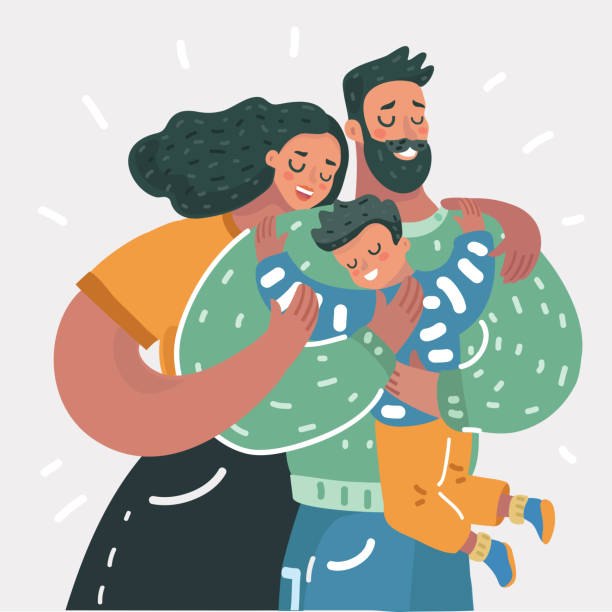
2,085 Father Hugging Son Illustrations & Clip Art

The last year of Covid was scary for our family.  At the beginning of the pandemic my husband worked on the frontline for three months straight without any break. With the tons of patients he was taking care of, I felt sure he would get Covid. I thought, “He’s not in the best of health and what if he dies?”  It felt inevitable that something terrible would happen.  This freaked me out and I went into survival mode. 

Also, I wanted to protect our kids as much as possible – but I couldn’t stop asking myself what I would do if our kids had to grow up without their father. 

And then there were the day to day deprivations: my husband would come home after a 15+ hour day but the kids and I couldn’t even hug him. Before we got to see him every night he had to perform a routine of entering through the garage, disrobing and taking a shower; it was only then that we could get close to him.  My kids and husband did “bubble hugs” (hugging the air) if we happened to see him outside before he got to do his disinfection process. 

And he and I slept in separate bedrooms for months because God forbid if we both got Covid – who would take care of the kids? 

My husband felt like a hero to me and to my children and I felt so guilty that after serving so selflessly each day, he had to be treated like an alien in his own home. But we knew it was necessary.  He even had his own designated sofa in our family room that we coined the “nether couch” that only he was allowed to lie on. I felt so isolated and lonely.  Both of my parents are physicians and yet they were unable to relate to what we were going through; they generally regard us as superhuman and basically thought we would be fine. Those first couple of months were truly the scariest moments because of the large possibility that I could lose my husband. We did not know the contagion risk and the true mortality numbers amongst health care workers at that point. I have gotten through a lot of adversity with him by my side but what would I do without him?  I often cried myself to sleep.  

I tell my husband everything and we have an honest relationship – but with all that he was going through I couldn’t and didn’t want to add to his burden. I thought that telling him about my fears of his getting Covid and dying would just be too much for him.  We stayed up most nights so that he could unload the days’ events. I listened patiently but I think I cried more than he did as he recounted his stories.  I felt his helplessness during those early days when the treatment for Covid was not standardized yet.  

I also worried about the kids and how my anxiety about my husband getting sick was being projected onto them.  Thank goodness we had a trampoline; they spent a lot of time on that trampoline! I’m also glad that the kids had each other.  But during this year not everything was scary – we got closer as a family, lived life a lot more simply, cooked a lot more and celebrated birthdays at home. Surprisingly, each child remarked that this birthday was their best ever.  

We took things a day at a time and we were able to relax a little more when the incidence of Covid slowed over the summer. Thankfully, the prospect of the vaccine was becoming more real through the Fall My husband was able to get vaccinated the first day the vaccine was offered – December 18th – because of his priority designation. As a physician, I was able to be vaccinated about a month later, and fortunately our parents were able to as well. This enabled us to feel more comfortable gathering and being close with one another.  I’m grateful for our good health and the fact that we made it through this scary time safely. Now we are planning our return to “normal” and we have travel plans to look forward to. Thankfully life in the hospital has improved steadily and the strain has lessened considerably on my husband, myself and my children.  

Reflecting On A Hard Year, Part 2: One New Mother’s Experience

The hardest part of this past year for me was fearing how the virus could affect my pregnancy. I was two months pregnant in March 2020 when we went into lockdown.  Limited information began to trickle out of Wuhan, China about the minor negative impacts seen in babies born to Covid positive mothers. But I knew these were all women who had gotten Covid in their third trimesters. Who was to know if Covid wasn’t the next Zika, the latest in a subset of viruses known to cause significant birth defects, especially early in a pregnancy when the baby is still forming its basic parts? 

I did not want to risk catching this virus. 

As a doctor myself I knew the basics of what happened at routine obstetrical appointments. With that knowledge and the consultation of my friends in the field, I concluded that the benefit of being at the routine appointments in person did not outweigh the risk of exposure to Covid-19. This was before the CDC recommended people wear masks. This was months before my OB office required that many of these appointments be virtual. How nice to be ahead of the curve. 

But I missed the face-to-face interaction and the physical touch from people trained to help me navigate my first pregnancy. I missed childbirth classes. There were only so many zoom interactions I could have in a week. I was so fortunate to be able to move my psychiatric practice online. But it meant spending the entire day interacting with people virtually. Very few of us had done anything like that before Covid.

Breathing heavily behind an N-95, I went to my twenty-week anatomy scan ultrasound. At the end of the appointment, the doctor handed me a napkin and said to use it to turn the doorknob on my way out.  Everyone was scared. That was early May 2020, well before we had clarification on surface transmission not being a great risk.

The birth itself was too big an experience to have been significantly influenced by Covid related precautions. Wearing a mask throughout the labor and the delivery was the least of my discomforts. And thankfully, my husband was allowed to be in the room.

The threat of Covid affected me more in terms of the difficulties of introducing my newborn daughter to my family. My seventy something year old parents were willing to quarantine heavily before meeting the baby, but what if we had gotten infected in the hospital, were asymptomatic and then gave it to them? This was not what we wanted to worry about while getting to know our newborn. 

And then there were my husband’s parents living in a foreign country, also in their seventies. It seemed too risky to have them fly over. So, everyone had to wait until they were vaccinated, about seven months after our baby was born – and that felt like a long time. 

I’m so grateful that the threat of Covid is diminishing now and that I’m able to experience having a young child with less day-to-day fear and more opportunities for healthy social interaction. 

Reflecting On A Hard Year, Part 1

The reflection in the water shows the biggest challenge you will have to  overcome. - Africa Revealed

Dr. Corinne Masur

Now that things are opening up again and many children will be back in school until June and then off to camp or other activities, parents have a moment to reflect on this past year.

Never, ever, in any of our imaginations, could we have imagined a year like the one that we just had.  

EVERYONE suffered so much loss.

Some of us lost loved ones, some of us were ill ourselves, and ALL of us lost smaller things: our peace of mind, our feeling of safety, our freedom of movement, our ability to see those we loved when and how we wanted.

Have any of us even acknowledged all the losses?

I think it is important to name them and to mourn them.  I think it is important to give ourselves time to think about the past year and all we went through – and to grieve who and what we lost.  

Mourning requires stability and internal resources and it may not be until life returns to a more normal state that many of us will actually be able to have the stability to reflect and grieve our losses from this past year.  It is important to recognize this and give ourselves space and time for our grieving processes.

And we also need to go over this with our children – whether they are young ones or teenagers.  We can say it over and over again: we ALL had a hard year last year.  We need time to think about what we went through and to talk about it and to recover from it.

Whatever our children are experiencing now – elation over going out into the world again, anxiety about doing things they have not done for a year, or some of each, it will be important to remind them of what they have been through and how it has affected them AND us – and how different life will surely be going forward.

Playground Etiquette

fighting over toys Archives - SPARE THE KIDS

Another humorous post by Tejal Toprani Misra who is a psychotherapist in part-time private practice and a most-time stay at home mom. She lives in California with her spouse and two young sons.

Playground etiquette … What is that anyway? I wish there was an “Ask Tejal” column on this topic. There’s a lot I could say.

What’s that? You’d like to know what I have to say? OK, I think I’ll just go ahead and say it:

So last month my boys, ages 2 and 5 had “spring break.” Not the “let’s go the beach and somebody hand me a Piña Colada” kind of a spring break – but the kind where I have to entertain two kids in a pandemic while my husband works the whole ten days kind of spring break. At some point the three of us forgot what my husband looked like. But I digress. 

For some reason, I decided to graduate myself to taking two kids to a public park. I wanted to see if I had any zone defense skills. Spoiler Alert: I don’t have any. This may be shocking to some readers but I have never taken them both “out” on my own. When our youngest was 15 months old and I was finally getting my “two kid mom wings” a pandemic hit and local parks had SVU caution tape around them. DUN DUN. I put my training wheels back on, my wings aside, and waited things out. Now one year later I put on the Rocky music and said “I can do this.” 

In order to control some of the elements as well as my own anxiety, I got there early, brought snacks, prepared for bathroom trips and brought a ball. A ball. Yes, one shareable item. 

The golden rule of park etiquette according to me is:

  1. If you as a parent allow your child to bring toy(s) to the park then you have to be able to handle the fact that those toys may want to be shared by other small park patrons. 

Let me explain how I created this rule. Over the 10 day “spring break” (but who’s counting?) when I decided to take my two children to the park, I saw a dad with a 4-year-old. And when I say he was “with” a four-year-old, I mean “with” figuratively. He was more letting his child play with 7 large dump trucks he had brought from their home while his head was down in a tiktok rabbit hole. 

My 2- and 5-year-old were immediately interested in the truck-a-palooza. And since the park is a shared space, they assumed these items were shareable as well. I asked Tiktok dad if he was okay with sharing and he nodded in the affirmative. His 4 year-old seemed to be okay with it too. And for about 120 seconds everyone was in harmony. That is, until the 4 year-old started to feel some type of way about his toys being played with by others. Remember, he brought them from home, to a public park, in a pandemic, where other children were desperate to see new faces and new play things… My 5 year-old understood. He moved on and other park friend parents sweetly offered their less coveted toys like buckets and shovels. 

Tiktok Dad took this as “problem solved” and resumed his phone activity. 

My 2 year-old, however, was not having it. 

How could he grasp that these toys, the ones brought to the public park, that he was just playing with, were now off limits? Well, he couldn’t. So, this led to a full scale tantrum. The kind where I am physically dragging him from the dump trucks and he’s trying to jump out of my arms. I tried all the things – which for me means distracting and bribing – and none of that worked. My two-year-old ran back to the dump trucks and grabbed one and ran away. The 4-year-old owner of the dump trucks became upset, and when I brought the truck back to the four-year-old a minute later the Tiktok Dad had the audacity to say “two is a tough age.” 

No s**t Sherlock! Of course, it is when you bring toys to the park and then don’t have the wherewithal to manage the consequences of those actions. Was I in the wrong? Was my two-year-old supposed to understand the mood shift of the dump truck owner? 

I don’t think so. 

Tiktok Dad should have said “no” to bringing the dump trucks to the park or had a conversation about sharing with his child. To quote Renee Zellweger in Cold Mountain “It’s like being in charge of the weather and then crying about the rain.” Just typing this out has got me heated. I need an ice tea.

Uncertainty Distress

sad kullfi kumarr bajewala GIF by Hotstar

Dr. Corinne Masur

Today I learned a new term.

I was reading scientific journal articles about how the pandemic has affected people and I came across it:

Uncertainty Distress

This term was coined to describe the “unknown-ness” in our lives right now and to highlight the distress being experienced by all of us during the pandemic, even when we are not in especially threatening circumstances at the moment.

And I am glad to now have a name for what everyone – children and adults alike – has been feeling. We don’t know what the summer will look like. Or the fall, for that matter. Will kids be able to play together? Will kids’ sports leagues operate? Will pools be open? How about camps? And later, schools and colleges?

And for the adults: will we go back to the job or the office? Will businesses that closed reopen? Will the jobs that evaporated become available again? Will people feel safe shopping in person? Getting haircuts? Taking the train or a plane? Meeting at each other’s houses and apartments?

Even though half of all adults are already vaccinated in the US, and more than half of the UK population has received at least their first dose, we STILL don’t know what the summer or the fall or the future will look like.

And this is VERY stressful.

Children are used to having their parents be able to answer their questions. But for all of us, the answer to the questions above – and all the others we have – are elusive. When we try to answer our children’s questions, we either have to be honest and say we really don’t know the answers right now – or we have to guess.

Neither option is ideal.

Kids want certainty. Kids like to know what to expect. Kids want their parents to know the answers to their questions. This makes them feel safe.

And we adults would like some certainty around now, too. It would make us feel safer, too. Will the vaccine protect us against the Covid-19 variants? Will the vaccine confer immunity to Covid 19 for at least a year? These things would be important to know.

Except we don’t.

So we all experience some degree of “uncertainty distress”.

Not knowing is hard.

The best thing we can do right now is to try to figure out how to live with uncertainty and how to help our children to live with it too. Tolerating difficult emotions is not something most people know how to do well. And yet, life is full of difficult emotions. Helping our children to learn how to live with difficult emotions is one of the best things we as parents can do.

So how do we help our children to do this?

In addition to the things you may already be doing, here are some suggestions:

-In times of uncertainty, it is best to keep the things that you CAN control stable.  Routines are important.  Try as best you can to keep bedtimes and meal times regular.  Try to maintain any family customs you have set up during Covid time – Friday night pizza, Wednesday night tacos, Saturday night movie, whatever.  Children tend to like routines and traditions even if they sometimes rebel against them.  These routines and schedules also provide some predictability in circumstances that are otherwise unpredictable.

-Provide children with something to look forward to. This gives a sense that good things CAN happen and that some things can happen according to plan.  Even if the things are small – a trip to a drive through for take out, a day trip to a State Park or a picnic at a favorite playground.

-Acknowledge children’s feelings, whatever they are. For example, if your child says, “I’m sick and tired of you saying, ‘I don’t know!'” You can respond, “You’re absolutely right! I’m tired of not knowing! It’s really hard right now, isn’t it?”

-Tell them stories from your own life of times you didn’t know how things were going to turn out – and then what happened.

-Tell them about times in your life when you were frustrated or bored or angry (tie it to what they are feeling at the moment).

-Thank your child for telling you how they feel. Even if you are at the end of your rope and the feeling your child is expressing is not particularly welcome at the moment, try to say, “Thank you for telling me how you feel”. Even if the next phrase is “but I’m sorry we cannot have pizza again tonight” or “I just can’t tell you whether camp will be open or not”, try at least to let your child know that it is a good thing for them to tell you what they are feeling.

-Reassure your child WHENEVER possible. Even if you don’t know the answer to their questions about when things will get back to normal, you can still rub their back (if they’ll let you) and remind them that you are keeping them as safe as you can and as soon as it is OK, you will make sure they get to go back to doing whatever it is they are missing at that moment.

-Talk about how hard not knowing is for you. Talk about what you do when you don’t know how something will turn out. Talk about how sometimes we all have feelings that are hard to bear.

-Distraction. After you have done all of the above, (probably over and over again), get out the cards or the board game, take everyone for some drive thru or take out food, suggest a hike or make some popcorn and put on a silly movie. (I recommend “The Pink Panther”)

-But most of all, try to model having difficult feelings, accepting that they are part of your life, that they can be talked about and that they can be survived. If you’ve gotten angry or if you’ve shown your frustration or your exhaustion, talk about it later. You can tell your kids something along these lines, “You know, I was really tired last night and I yelled. I’m sorry, you didn’t deserve that – but right now things are really hard and I think we are all having a hard time – and we need to do the best we can.

Take care, and remember, you are not alone if you are feeling distressed at all the uncertainty in your life right now. We are ALL experiencing this uncertainty, and it IS distressing.

* (Freeston et al., 2020).

The Dreaded Child Care Decision!

KRizz robin williams mrs doubtfire help is on the way help is on the way dear GIF

Dr. Corinne Masur

Now that more daycares and preschools are opening up again, parents are asking themselves, “What is the best child care arrangement for my child?  How long is OK for my child to be in child care each day? What should I look for in a childcare provider or daycare?” and so many other questions related to child care.

The best way to make an informed decision about this is to consider three basic questions:

  • What are our family’s needs for childcare right now given our work schedules?
  • What are our options for child care?
  • What is best for our child given their age? 

This is a hard thing to talk about.  Parents need to work.  Parents want to work.  Women AND men have a place in the working world that is important. But one enormous problem is the fact that in the U. S. and most of the Western world, we live in societies that still expect women to take care of the children most of the time. In the U.S., our society does not support women, or parents in general, by providing sufficiently long parental leave after the birth of infants to care for the baby in an optimal way AND it does not provide universal high quality childcare for babies and toddlers once their parents have to return to work.

So – we have to talk about this.  

This post will not be about what parents should or should not do.  I am just going to try to describe the various child care options and provide some developmental information to consider.

Child Care Options

  1. Home care: 

Home care is a wonderful option for the newborn to the two year old.  If one parent does not work, then that parent can do the child care full or part time if that works for them. Or parents can trade off depending on schedules and ability. If both parents work or if there is only one parent,  a relative, friend or sitter who can take care of your baby during your work hours is a possibility.  If this person is loving and experienced with babies, this is a great option. A nanny share is also a good possibility.  Can you get together with a friend or two and have a babysitter take care of your children together? This simulates a family situation if you have a loving, experienced person to share with a friend or two (who have values and needs similar to your own) this can be a great option – as long as you work out the terms of the nanny share in advance of beginning!

  1. Out of home care: 

Small neighborhood day cares are a nice option which some parents choose.  What should you look for?  When you visit make sure you see each child or infant receiving the individual attention they need.  Make sure there is always one or two adults consistently available for each baby or toddler and that the babies are not just cared for by whomever out of the four or five adults available at that moment.  Make sure that there are never more than three babies or children being cared for by one adult at a time.  Find out how the daycare handles illness amongst the babies (Are they allowed to attend when ill?  How are they cared for in a way that ensures that other babies will not become ill? What are the hygiene practices at the daycare?) Make sure the babies get outside at least once a day in a stroller.  And make sure there is both a soothing environment available for nap time and a stimulating area available for play time.

Larger daycares can also be a good option for working parents – with a few things to keep in mind. First, the daycare needs to be clean and well organized. Second, good hygiene practices around illness and contagion should be in place.  Workers should wash hands each time they feed or diaper a baby or toddler. Third, look at the staff to child ratio. Fourth ask about what the actual practice at the daycare is in terms of who goes to your baby when your baby needs feeding, diapering, comfort, or play time.  What would be optimal is a day care whose practice it is to assign one or at most two workers to your baby so that your baby consistently interacts with the same person and learns that person’s rhythms and reactions in order to form a relationship with them.  Also, ask the daycare what their staff turnover rate is.  You want a day care which treats its staff well and where staff stay for years at a time so that your baby or toddler can be assured of seeing the same caregiver day after day so that they can establish a stable, consistent and loving relationship with the same one or two people there. It helps your baby feel comfortable, safe and secure to see the same face every time. 

Developmental Considerations

What option you choose can partly be guided by the age of your baby or toddler:

0 -1

The baby from birth to around one year of age is learning how to regulate their body and their feelings.  At birth, as every new parent knows, babies are not on a schedule.  They do not eat or sleep or poop at any specific time.  The caregiver’s job in this first phase of life is to provide prompt attention to the infant’s need for food, a clean diaper and soothing when they cry or fuss or feel uncomfortable. It is important that the caregiver also provides plenty of face to face time so that the baby can see their moods and feelings mirrored in the face of the caregiver as well as becoming accustomed to the rhythms and routines of that caregiver. This kind of attention to the baby’s bodily cues and emotions helps the baby begin to regulate.  From birth onward through the first year, what the baby really needs is one or two or three central caretakers – mother, father, grandmother, grandfather, aunt, friend, babysitter or childcare worker (who is assigned to your baby). In other words, the baby needs a consistent caregiver who is responsive to their own particular and unique moods, feelings and bids for engagement.  

Also, babies under one year of age do not NEED socialization with other babies, no matter what anyone tells you.  They need responsive love and care from one or two or three main adults (and a few other people from time to time when available). And they need time for play and stimulation from these caretaker(s) which might include activities like playing with toys on a blanket, music time, book time, and outdoor time in the stroller.

1 – 2

Later in development, as the infant becomes a toddler, the parent or caregiver is the bedrock from which the toddler begins to move into other relationships.  At this age babies are gaining mobility and interest in the world.  They love to see other babies and older kids.  They love to imitate them and to try to do what they are doing. At this age they still need their one or two or three consistent caretakers but they can also begin to spend time with other children, doing motor activities like running and climbing and chasing, and listening activities like short story or song times. 

2 – 3

At two and a half to three years of age, most children can begin to tolerate a full day of preschool or daycare – but if you can keep it to around six hours per day, that is best. More than that is a very long day for a young child. Longer days of ten and twelve hours can be taxing on an infant or toddler and require an extraordinary use of the child’s inner resources and coping mechanisms. If your work day is long, think about whether you can combine preschool or daycare with some hours at home with a relative or sitter.

Overview:

In other words, situations designed to provide your baby or toddler with the care of one or two or three consistent and loving people who will respond quickly to your baby or toddler’s needs and who will provide the facial and vocal mirroring and feedback, as well as the love, soothing and the stimulation that your baby or toddler needs, is optimal. 

Other questions

  • How long per day should my baby be in care?

Here there are also developmental considerations.

From around sixteen months to two and a half years of age, your baby’s developmental capacities begin to change.  At this age something important begins to happen.  Your baby can begin to remember you (or whomever the primary caregiver has been) when you/they are gone.  This is the beginning of what is called object constancy and this is what makes it possible for the baby to begin to have periods of time away from you (or the primary caretaker) without suffering too much.  

If your toddler can remember you when you are not there, this provides some of the soothing that they need in order to be independent from you.  At sixteen months this capacity is temporary – the ability to remember the primary caregiver when they are not present lasts only a few hours.  At two and a half it lasts a bit longer and at four your child can usually keep you in mind for a whole day.  This does not mean they will not miss you – but it does mean that they can survive without you and be OK.

  • What is optimal for my baby?  

It is optimal for your baby or toddler to be cared for by one or two or three consistent caregivers for the first year to two years of life – if possible – whether those caregivers are mother, father, grandmother, babysitter or daycare workers who are consistent and assigned only to a few babies at a time.  

  • What about when my baby is older?

At sixteen months to two years of age, added stimulation is helpful.  A full blown curriculum is NOT necessary.  Toddlers do not NEED to learn numbers or letters – but they DO benefit from a rich and stimulating environment where free play and socialization is encouraged.  A good day care can do this as can two to three hours a day of a play group, or preschool.

  • Can I mix and match child care arrangements according to the day of the week?

Try to keep each day the same.  OR have a couple of days of one schedule and a couple of an alternate schedule. But try NOT to have each day be different.  Babies and young children LOVE routine.  It makes them feel safe and secure. Three days a week of half day preschool and two days at home or with a babysitter is a good schedule for a two year old.  But one day of all day daycare, another day with grandma, another day of half day daycare, a fourth day at home and a fifth day with a family friend could feel disruptive and confusing for an infant or toddler.

         – How do I evaluate how my baby (or child) is doing once I have made my choice of childcare options? How do I tell if my child is having a negative reaction to a daycare, preschool or other childcare situation?

  1.  Look for signs of exhaustion including a greater degree than usual of fussiness, signs of tiredness even in the morning or at midday.  
  2. Look for signs of anger, dysregulation or confusion. 
  3. After the first three weeks of this arrangement does your child STILL seem tired, fussy, or confused?
  4. Is your child’s eating or sleep routine disrupted?
  5. Does your child cry for more than fifteen minutes after you leave?

These are signs that a change may need to be made in your arrangements for childcare. 

Of course it is normal for your baby or young child to cry when you drop them off at daycare or school.  They don’t want to leave you!   But how long the crying lasts is informative. Ask the worker or teacher how long your child cries. If it is for five to fifteen minutes, don’t worry.  But if it is for over an hour, this is of concern. Ask about your child’s mood for the rest of the day.  Do they seem happy? Content?  Or fussy and whiny? Watch their behavior and moods at home.  Has their attitude toward you changed since starting daycare or school or has it stayed the same? Again, this information will help you to decide whether the arrangement you have made is working or not.

The choice of how to best take care of children during the day is a hard one for working parents – especially those who do not have available family nearby.  Think about your needs AND the developmental needs of your baby or toddler – depending on their age and stage of development – as you decide.

Did you find this helpful? Or do you want to contribute to the debate?  Either way, leave a comment!