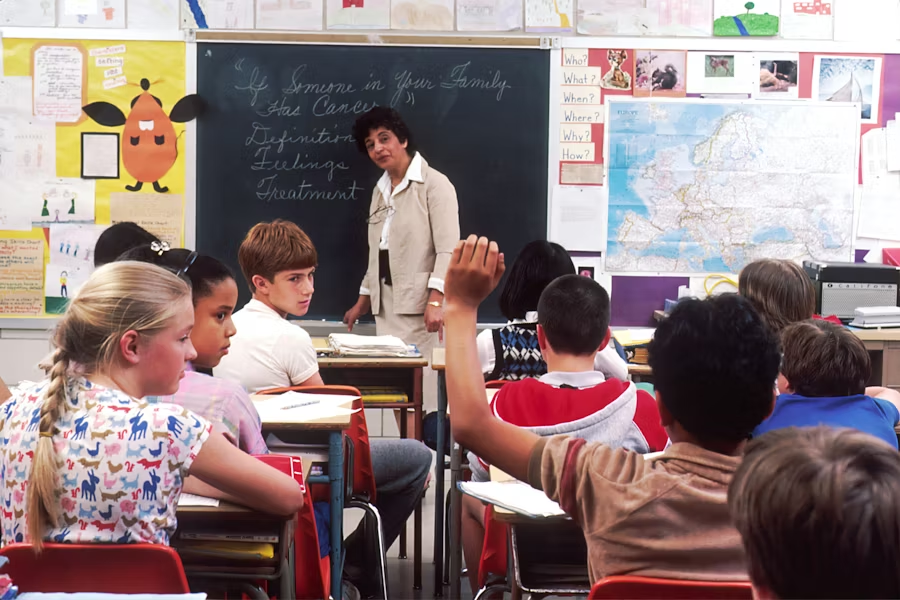
Have you wondered if your children or grandchildren are getting the education they need? Do you wonder if they are really learning what they need to learn and whether it will prepare them for college…or for life? Do you ever wish that schools would ban phones from classrooms or that the United States would ban social media for kids under 16 so that your children could pay better attention to learning, sports, hobbies or even their friends?
I have worried about all of these things. And I have also wondered whether the recent popularity of theories backed not by science but by TikTok proclamations may be a result of the failure of our educational system to teach people how to evaluate ideas and to think for themselves.
We are in an era where opinion trumps science, where scrolling social media is preferred to reading books, where facts are no longer respected, and where screens win out over socializing in person. Whatever your politics, these trends do not bode well for our children learning how to relate to other people, to separate truth from opinion, to evaluate ideas for themselves, and to make cogent, fact-based arguments.
And because of our kids’ habitual use of phones and screens, attention to classroom teaching and homework is suffering.
David Bailey reported on just this in a recent article in Math Scholar. He said that we are experiencing a crisis in education—and he cited plenty of evidence:
- U.S. educational test scores are in a generation-long decline: From 2015 to 2025, 83 percent of school districts lost ground in reading, and 70 percent of districts lost ground in mathematics (Bailey, 2026).
- Twelfth-grade U.S. reading scores have dropped to the lowest level since 2005. Sadly, the declines have been greatest for those students from lower socioeconomic environments (Bailey, 2026).
- A working group at the University of California, San Diego, found that 900 of the latest incoming freshman class had mathematics skills below high-school level, and most of those did not even fully meet middle-school standards. Nationwide, college professors teaching mathematics and computer science courses report growing numbers of incoming students unable to do basic algebra or solve simple word problems (Bailey, 2026).
- Even at elite U.S. universities, professors report difficulties getting students to engage with full-length literature texts; in many cases, students have never read such “lengthy” works (Bailey 2026).
- Grade inflation is rampant at all levels. At Harvard University, the percentage of A grades soared from 24 percent of all grades in 2005 to 60 percent in 2025 (Bailey, 2026).
In this article, Bailey said that these changes in student performance are concurrent with the rise of smartphones, increased use of social media, and rising student absenteeism.
So it seems my concerns—and possibly your own—are justified.
While many people believe that this trend started during the COVID-19 pandemic—and while it is true that this period severely worsened the downward trajectory of student test scores—recent data from the Stanford Educational Opportunity Project shows that a “learning recession” actually began around 2013 (Miller et al., 2026). This report says that almost everywhere in America, students are performing worse than their peers did a decade ago. The term, “learning recession” was coined by the Education Scorecard, a joint project of Sean Reardon at the Stanford group, Thomas Kane at the Center for Education Policy Research at Harvard, and Douglas Staiger at Dartmouth (Miller et al., 2026).
In a recent New York Times article, Nat Malkus, a senior fellow studying educational policy at the American Enterprise Institute, said, “I cannot be more emphatic: This is an enormous problem that’s not getting enough attention” (Miller et al., 2026).
Students’ ever-present screens are potent sources of distraction. According to The Pew Research Center, nearly half of American teens say that they are online “almost constantly” compared with under a quarter who said the same thing a decade ago (Miller et al., 2026).
Moreover, schools are expecting less and less of kids. Students are required to read entire books far less often than in previous years. And their attentional abilities have also declined, resulting in less attention paid in the classroom and to longer homework assignments.
So parents, I hate to say it, but it is time to worry. And it is also time to do something.
Here are my suggestions:
- Make sure your child goes to school every day. This may seem obvious, but regular school attendance and a commitment to school are important for kids.
- Start going to the public library on a weekly basis when your children are around age 2. Take out the books they want and read them to them at home. When they are older, let them take out the books they want to read themselves.
- Model reading print books and magazines at home. Make sure your children see you reading books or magazines and enjoying it.
- Encourage your school-aged child to read for at least 10 minutes before going to sleep. This is a good, relaxing habit. And make sure their cell phone is not in the bedroom.
- During homework time, insist on cell phones being put in another room.
- Have your kids do their homework in a community space in the house where you can monitor what they are doing on their computers, making sure it is homework and not YouTube.
- Monitor your children’s curriculum. If you have concerns about it, or if you think it is not rigorous enough, speak up. Schedule a face-to-face meeting. Talk to the school principal. Demand more challenging work for your child.
- Monitor your children’s learning. If you do not think they are keeping up in reading or math or any of the other subjects, talk to the teacher. If the problem persists, ask for a formal assessment of your child’s learning and learning ability. Once a parent requests this, all public schools are required to set up an evaluation by the school psychologist.
- If you would prefer that phones—or even screens—not be used in the classroom, again, speak up. Talk to the teacher and the principal. Don’t be afraid to attend school board and PTA meetings and be vocal.
Parents, it is up to you to monitor your children’s education and to advocate for better services and policies if you do not think your children are getting the education they need. It is also up to you to instill good study habits—starting early—to help your children build their attentional capacities and to prepare them for the later school years and college.
References
Bailey, David (2026). The Great Dumbing Down of America, Math Scholar. https://mathscholar.org/2026/07/the-great-dumbing-down-of-society/
Miller, C., Paris, F., and Dervosh, S. Why U.S. Test Scores are in a ‘Generation-Long Decline.’ The New York Times, May 13, 2026. https://www.nytimes.com/2026/05/13/upshot/test-scores-school-districts-…