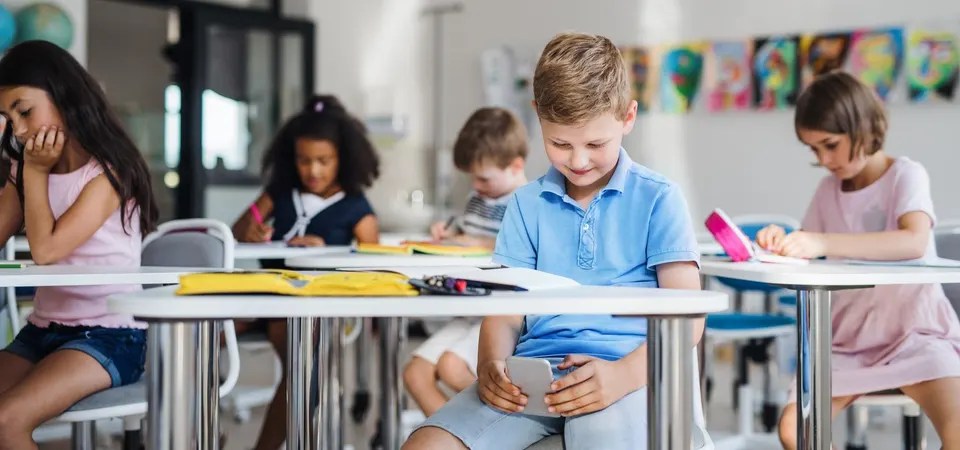
We Are in an Educational Crisis!

Have you wondered if your children or grandchildren are getting the education they need? Do you wonder if they are really learning what they need to learn and whether it will prepare them for college…or for life? Do you ever wish that schools would ban phones from classrooms or that the United States would ban social media for kids under 16 so that your children could pay better attention to learning, sports, hobbies or even their friends?

I have worried about all of these things. And I have also wondered whether the recent popularity of theories backed not by science but by TikTok proclamations may be a result of the failure of our educational system to teach people how to evaluate ideas and to think for themselves.

We are in an era where opinion trumps science, where scrolling social media is preferred to reading books, where facts are no longer respected, and where screens win out over socializing in person. Whatever your politics, these trends do not bode well for our children learning how to relate to other people, to separate truth from opinion, to evaluate ideas for themselves, and to make cogent, fact-based arguments.

And because of our kids’ habitual use of phones and screens, attention to classroom teaching and homework is suffering.

David Bailey reported on just this in a recent article in Math Scholar. He said that we are experiencing a crisis in education—and he cited plenty of evidence:

  1. U.S. educational test scores are in a generation-long decline: From 2015 to 2025, 83 percent of school districts lost ground in reading, and 70 percent of districts lost ground in mathematics (Bailey, 2026).
  2. Twelfth-grade U.S. reading scores have dropped to the lowest level since 2005. Sadly, the declines have been greatest for those students from lower socioeconomic environments (Bailey, 2026).
  3. A working group at the University of California, San Diego, found that 900 of the latest incoming freshman class had mathematics skills below high-school level, and most of those did not even fully meet middle-school standards. Nationwide, college professors teaching mathematics and computer science courses report growing numbers of incoming students unable to do basic algebra or solve simple word problems (Bailey, 2026).
  4. Even at elite U.S. universities, professors report difficulties getting students to engage with full-length literature texts; in many cases, students have never read such “lengthy” works (Bailey 2026).
  5. Grade inflation is rampant at all levels. At Harvard University, the percentage of A grades soared from 24 percent of all grades in 2005 to 60 percent in 2025 (Bailey, 2026).

In this article, Bailey said that these changes in student performance are concurrent with the rise of smartphones, increased use of social media, and rising student absenteeism.

So it seems my concerns—and possibly your own—are justified.

While many people believe that this trend started during the COVID-19 pandemic—and while it is true that this period severely worsened the downward trajectory of student test scores—recent data from the Stanford Educational Opportunity Project shows that a “learning recession” actually began around 2013 (Miller et al., 2026). This report says that almost everywhere in America, students are performing worse than their peers did a decade ago. The term, “learning recession” was coined by the Education Scorecard, a joint project of Sean Reardon at the Stanford group, Thomas Kane at the Center for Education Policy Research at Harvard, and Douglas Staiger at Dartmouth (Miller et al., 2026).

In a recent New York Times article, Nat Malkus, a senior fellow studying educational policy at the American Enterprise Institute, said, “I cannot be more emphatic: This is an enormous problem that’s not getting enough attention” (Miller et al., 2026).

Students’ ever-present screens are potent sources of distraction. According to The Pew Research Center, nearly half of American teens say that they are online “almost constantly” compared with under a quarter who said the same thing a decade ago (Miller et al., 2026).

Moreover, schools are expecting less and less of kids. Students are required to read entire books far less often than in previous years. And their attentional abilities have also declined, resulting in less attention paid in the classroom and to longer homework assignments.

So parents, I hate to say it, but it is time to worry. And it is also time to do something.

Here are my suggestions:

  1. Make sure your child goes to school every day. This may seem obvious, but regular school attendance and a commitment to school are important for kids.
  2. Start going to the public library on a weekly basis when your children are around age 2. Take out the books they want and read them to them at home. When they are older, let them take out the books they want to read themselves.
  3. Model reading print books and magazines at home. Make sure your children see you reading books or magazines and enjoying it.
  4. Encourage your school-aged child to read for at least 10 minutes before going to sleep. This is a good, relaxing habit. And make sure their cell phone is not in the bedroom.
  5. During homework time, insist on cell phones being put in another room.
  6. Have your kids do their homework in a community space in the house where you can monitor what they are doing on their computers, making sure it is homework and not YouTube.
  7. Monitor your children’s curriculum. If you have concerns about it, or if you think it is not rigorous enough, speak up. Schedule a face-to-face meeting. Talk to the school principal. Demand more challenging work for your child.
  8. Monitor your children’s learning. If you do not think they are keeping up in reading or math or any of the other subjects, talk to the teacher. If the problem persists, ask for a formal assessment of your child’s learning and learning ability. Once a parent requests this, all public schools are required to set up an evaluation by the school psychologist.
  9. If you would prefer that phones—or even screens—not be used in the classroom, again, speak up. Talk to the teacher and the principal. Don’t be afraid to attend school board and PTA meetings and be vocal.

Parents, it is up to you to monitor your children’s education and to advocate for better services and policies if you do not think your children are getting the education they need. It is also up to you to instill good study habits—starting early—to help your children build their attentional capacities and to prepare them for the later school years and college.

References

Bailey, David (2026). The Great Dumbing Down of America, Math Scholar. https://mathscholar.org/2026/07/the-great-dumbing-down-of-society/

Miller, C., Paris, F., and Dervosh, S. Why U.S. Test Scores are in a ‘Generation-Long Decline.’ The New York Times, May 13, 2026. https://www.nytimes.com/2026/05/13/upshot/test-scores-school-districts-…
Are Kids Safer at School With or Without Their Phones?

This is Part 2 of a series on phones at school.

In my previous post on the topic of phones in schools, I wondered why we haven’t already helped kids avoid distraction by putting smartphone bans in place at all schools. UNESCO has recommended that this be done worldwide 1and there are a large number of studies demonstrating why this is important.2,3

In researching the answer to this question, I found out that while some states have put legislation in place allowing school districts to enact smartphone bans at school, other states hesitate to do so because there are parents who are against this—and some have even sued school districts.4

Coincidentally, I recently received a notification from Delaney Ruston, M.D., who writes the blog Screenagers on just this topic.5

She wrote that one reason some parents object to kids not having their phones with them during the school day is that the parents think it is safer for them to have their phones in case of a school emergency. They want their children to be able to contact them.

Ruston has called for a national survey on the opinions of Americans as to whether children are safer with or without phones at school, but in the meantime, before such a study can be carried out, she did a little survey of her own—not scientific—but meaningful nonetheless.

She asked numerous people what they thought and these are some of the responses she received:

Superintendent

“We had a real-time emergency…We went into lockdown, and moments after that, students started communicating with their parents, texting, and calling from their cell phones. As a result, our first responders were arriving at the school, and we had parents lined up in our driveway, and the first responders literally couldn’t get their vehicles to our school. The driveway was backed up all the way to the street.

Police Officer

“I do not like children having access to their phones directly in school because of the safety aspect of it. You can’t get away from … the misinformation that gets presented. The slightest little rumor of a threat or the slightest statement that gets made, which isn’t investigated, gets circulated quicker than the police even get notification or before staff gets notified.”

Elementary School Principal

“When I was a principal at a high school, we had a lockdown occur one time, and because all of the students got on their phones immediately, the network of the school crashed, and then none of our phones worked.”

“I am not a proponent of cell phones, especially during an emergency situation.”

School safety expert who consults with schools across the country

One of the biggest arguments parents have is that kids should have access to phones, especially high school, during the day in the event of an emergency and a security breach. And, we tell them, no, the first thing we want to have is first responders in the building as soon as possible. We have to speed up our responses to emergencies, not slow them down.”

“I would like to see a policy where there’s no phones allowed, bell to bell. Period. Put in the lockers or some other kind of system where there’s accountability that those kids can’t access them.”

So, here are some experts, people on the ground taking care of kids and in charge of public safety, who say that phones do not make kids safer at school.

It is also important to consider that the use of cell phones during unfolding school emergencies can distract students from what they are being told to do by school staff to preserve their safety.

And beyond the potentially negative effects of cell phones used during emergencies, students have used cell phones to make bomb threats, plan school shootings, and make individual threats to other students. And phones have also been used for cyberbullying and for instigating and organizing fights and other safety disruptions at school.5

So, now that you have heard some of the reasons why smartphones may not actually make children safer at school, what do you think? Are children safer and better off at school with or without their phones?

References

1. https://devbusiness.un.org/news/unesco-calls-global-ban-smartphones-sch…

2. https://www.jeremyajorgensen.com/the-impact-of-cellphone-use-on-student….

3. https://pmc.ncbi.nlm.nih.gov/articles/PMC9676861/

4. https://files.eric.ed.gov/fulltext/EJ1287931.pdf

5. https://www.screenagersmovie.com/blog/how-phone-bans-improve-school-saf…

6. https://schoolsecurity.org/trends/cell-phones-and-text-messaging-in-sch…

Should Schools Ban Cell Phone Use During Class?

In September 23, 2024, Governor Gavin Newsom signed the Phone-Free Schools Act into law. This legislation requires all public schools in California to develop and implement policies restricting student cell phone use during school hours – unless needed for individualized instruction, medical necessity or an emergency situation. 1

Meanwhile Florida banned phones altogether as of July 1 of this year. 1

In Connecticut the State Board of ED introduced voluntary guidelines this past summer allowing individual school districts to design their own policies. Guidelines suggest that elementary and middle schools remove all cell phones and similar devices – but they do not mandate it. 1

Indiana is a little stricter, having passed a law which went into effect July 1 of this year requiring all educational institutions to establish guidelines for prohibiting phone use in classrooms. 1

In Delaware, money has been set aside for a cell phone pilot program which will require students to put their phones in pouches during the school day. 1

And the variations continue, state by state.

But why?

There is a large body of literature that looks at smartphone use and academic performance.

And, as might be expected, smartphone use is associated with poorer course comprehension, lower GPA’s, poor sleep quantity, decreased life satisfaction, and higher rates of anxietyloneliness, and depression. 3

It has been well documented that cell phone use in class is also a common source of distraction and leads to decreased focus. 2

In a study of college students, one group whose cell phones were removed were compared to another group of students who were allowed to keep their cell phones. Results indicated that students whose smartphones were physically removed during class had higher levels of course comprehension, lower levels of anxiety, and higher levels of mindfulness than the control group. 3

We know that cell phone use at school also facilitates cheating on tests, as well as allowing sexting and cyberbullying during class time.

And if all that were not enough, UNESCO has called for a WORLDWIDE ban on cell phone use in schools. 5

So why have we not done more to help our kids stay away from their cell phones during the school day?

Well, as it turns out, parents don’t always like cell phone bans. When The Department of Education in New York City implemented a district-wide cell phone ban in 2005, parents sued. They weren’t successful in overturning the ban, but they did spend a considerable amount of resources to challenge the ban. Lawyers for the parents argued that the board overreached its authority by denying parents their constitutional right to stay in contact with their children in school. The challenger also alleged that the cell phone ban violated the U.S. Constitution because it “infringed on parents’ fundamental right to provide for the care, custody, and control of their children” (Price et al. v. New York City Board of Education, 2007, p. 7) 4

It turns out that banning or restricting cell phone use in schools is extremely controversial. In an article summarizing the lawsuits which have been brought against schools which implemented policies restricting cell phone use, the authors concluded that to prevent further law suits, educational leaders need to develop cell phone use policies and apply them carefully when disciplining students who violate their provisions. The authors of the review found that the courts are generally willing to defer to the authority of educators to enact reasonable cell phone policies in order to preserve school safety and security.

Where do YOU stand on your kids using their phones in school?

Is your desire to communicate with your child during the school day more powerful than your wish to protect your child from distraction during class?

Think about it.

https://www.newsweek.com/map-shows-states-school-cellphone-bans-1958547….

https://www.jeremyajorgensen.com/the-impact-of-cellphone-use-on-student….


https://pmc.ncbi.nlm.nih.gov/articles/PMC9676861/


https://files.eric.ed.gov/fulltext/EJ1287931.pdf

5 https://devbusiness.un.org/news/unesco-calls-global-ban-smartphones-schools