
When “Good Enough” is Not Possible 

By Karen Libber Fishbein, MSW
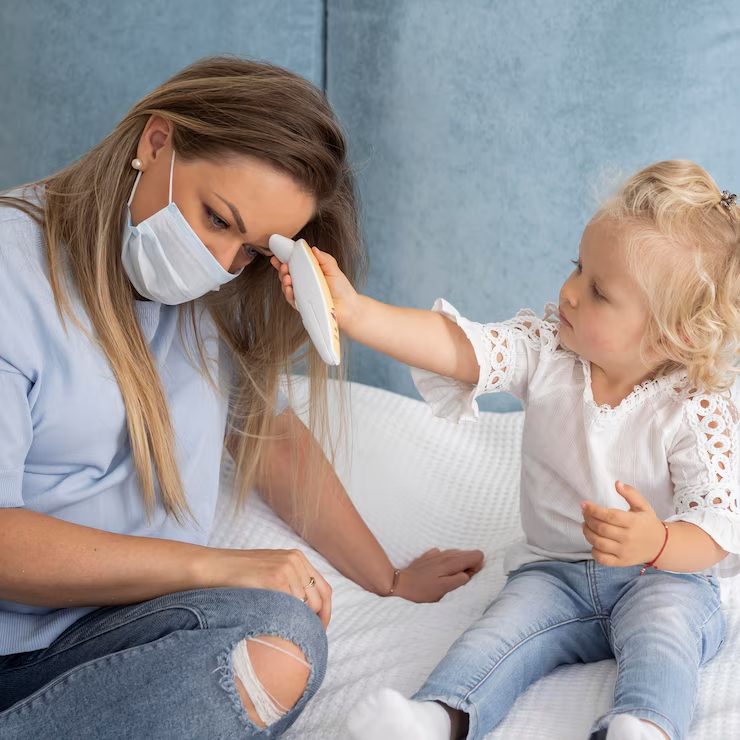
Sunday, May 11th was Mother’s Day. Articles about grief kept coming up on my newsfeed. Women missed their wonderful mothers.  

But I would like to discuss a different kind of grief  – a kind that some mothers (and fathers) experience – and not just on Mother’s or Father’s Days – but on a regular basis. This is a kind of grief that is harder to name and conceptualize. It is the grief of knowing that being able to provide “Good Enough” parenting is not always possible. 

It is a grief I encountered on Mother’s Day last year.

In 1953, pediatrician and psychoanalyst, Dr. Donald Winnicott, coined the term “The Good Enough Mother.” A “Good Enough” mom is a responsive and nurturing figure who does her best to meet her children’s developmental needs but who may not always do everything “perfectly”. This is in contrast with the notion that many parents have these days of having to keep their children happy at all times. It recognizes that parenthood is a difficult job where mishaps and misattunements will inevitably occur. 

The idea that I did not have to be a perfect mother, but just a “Good Enough” parent provided me with much solace over the years and helped ease some of the pressure that goes along with raising children. 

But this solace shifted once I was in a position where I could not even be “Good Enough”. 

In December of 2022, I contracted the Coronavirus for the second time. The initial infection was quite mild, but unfortunately, once the COVID symptoms started, they never stopped. To this day, they’re still affecting me, though I’m finally almost back to my baseline. As part of the Long COVID journey, I took a turn for the worse from November of 2023 until September of 2024. During these 11 months, the Long COVID symptoms dramatically reduced my ability to function. I found I could only do the bare minimum of parenting. I remember having to force myself to get out of bed or pick my kids up at school. Trying to keep a smile on my face when I felt so awful was extremely difficult. Housework was nearly impossible,  and sitting down with my kids to play a game or help with homework was not happening. I was fully aware of the various struggles my girls were having and I simply could not muster up the strength to support them.

Intellectually, I knew all of the things I was supposed to do to be a “Good Enough” mother – but physically, it was impossible. I felt completely unable.. My symptoms involved feeling  achy and uncomfortable all day as well as experiencing extreme fatigue. The final diagnosis of one of my particular problems was “irritable larynx syndrome”. Thankfully, this is treatable, and I’m expected to make a full recovery.  However, living with this for a year and a half has been very difficult. When symptoms were most severe, I needed to use heat and steam daily and I had to spend six to eight hours a day resting in bed. I was still working and I had two children to take care of, so needing to spend this much time on bodily care meant that many tasks went undone.

My illness would have been bad enough if it had just affected me, but as a mother, it felt terrible to know that it also affected my family. However, as many negative effects as there were, I was surprised to see that there were also some positive effects. 

The negative effects included my husband and kids feeling frustrated with me, the kids not having as much of my support with schoolwork or other pursuits, and their being bored when I was too sick to plan activities. There were many days where they spent way more time on screens than they should have. And as far as socializing with friends and neighbors was concerned, there were multiple events I had to skip. 

Interestingly, with all the things I couldn’t do during this time, one of the major sources of annoyance for my kids was me clearing my throat and massaging my larynx. They just hated the sound of my doing these things – and my younger daughter, in particular, had a visceral response to them. She and her sister nicknamed me “The Hock Monster!” Though we can laugh about the nickname now, there is also a bittersweet aspect that goes along with it. At one point, my younger daughter asserted, “I just want a normal mom!” 

But, there have also been some significant areas of growth for my family as a result of my illness. For better or worse, out of necessity, both of my kids had to step up their game and learn to be more independent. My 12-year-old is fully in charge of her own laundry now! Both kids have honed their empathy skills and have tried to understand and support me when they see I’m not feeling well. They’ve also gotten much closer to friends, family and neighbors.  As they say, a village is needed when raising children, but it is of the utmost importance when a parent is sick. 

I am so thankful to those who showed up for my family when I was down for the count.

Additionally, I owe my husband a great deal of gratitude. His TLC and efforts to keep everything together for our family during my prolonged health struggle were essential.

And, as I’ve gotten better, the family has become visibly healthier and happier. A major area of growth for the family system is that my husband and I are now team players as we navigate daily responsibilities. This is something with which many couples struggle. Long COVID forced us into a reset, and a more balanced system has remained intact even now that I’m feeling better. 

Many people have heard of Post Traumatic Stress Disorder (PTSD). I’m sure as my family and I look back on the time I was ill, there will be painful, traumatic feelings. But another less well-known concept is Post Traumatic Growth. Despite the hardship my condition has caused, I truly believe that the growth my family has experienced during my illness has been extraordinary. And for me, as I heal, I have a new take on life. I’m living each day to its fullest and I am beyond grateful that I’m now able to show up for my children and family with an almost entirely healthy body. And also – we’re certainly going to be celebrating when my symptoms are fully resolved.

Why Aren’t Kids More Independent?

Kids aren’t doing things independently as much as they used to. This is the thesis of a recent podcast by Screenagers founder, Delany Ruston – and I highly suggest you listen. (See below for link)

Her first premise is that kids are less independent because they spend so much time watching screens. And her second premise is that kids are less independent because of parental anxiety and the restrictions parents put on kids as a result.

Her guest on the podcast is Lenore Skenazy, author of Free Range Kids, the “terrible” mother who let her nine-year-old son ride the subway in New York City.

Well, let me just say, I rode the public bus when I was nine – and I did it because I wanted to. I also went to spend overnights with my best friend – and from the time we were about six, her mother, who didn’t like to cook, would send us to the corner store for lunch.

This was fun. This was exciting. And we didn’t get kidnapped.

But these days, when we see kids riding the bus or the subway at nine or ten and those who walk around alone or with a friend at six we think they are being neglected, possibly abused and definitely in danger.

However, Dr. Ruston said an interesting thing. She quoted a mentor of hers as having said, “People do not mature in preparation for responsibility – they mature as a result of it.”

And from my own personal experience, and as a child psychologist, I have found this to be true.

My father died when I was 14. I started to be the one to lock the doors at night, just as he had once done. I mowed the lawn, as he had done, and when I was 15, I got a job. 

I didn’t do these things because my mother yelled at me and told me I had to. I did these things because I wanted to. And doing these things actually felt good. Doing these things made me feel more confident and more able.  And when I went away to college, I felt prepared to handle myself independently.

Did my boss at work yell at me? Yes. Did she tell me I was terrible at my job? Yes. But I still enjoyed working for her and I REALLY enjoyed getting that paycheck.

Meanwhile, in my practice, I am seeing college-aged kids who don’t seem to know how to do so many things, who seem self critical, who seem to lack confidence and who seem to prefer to sit on their beds and scroll. I see college kids who need to text a parent multiple times a day. And I see college kids who, once they have an internship or a job, can’t stand a moment of criticism and feel like they have the right to push back immediately.

I think these college kids are not used to being independent. I think they feel unsure of themselves and they need to check in with parents to see if what they are doing or what they might do is OK. Often these are the kids who were driven everywhere they needed to go and who were given advice about everything they needed to do.

Of course, their parents restricted their independence out of fear. The kidnapper, the accident, the rapist lurked just around the corner. And their parents gave advice because they wanted the best for their kids. They hired the college consultant because they were unsure about whether their own judgment or their kids’ judgment about which colleges to apply to were good enough. They kept their kids from having jobs because they wanted them to get the best grades they could. They scheduled their kids with activities because this is what they thought was best for their kids.

But does constant protection and constant advice give enough room for kids to experience life for themselves, to make some mistakes, to learn how to handle a yelling boss or a bus that never comes?

I think we all know the answer.

And for the ubiquitous phenomenon of overprotected kids, over anxious kids, and over anxious parents, I, like Dr. Ruston, blame screens. But for once, I don’t blame the screens the kids are on. I think part of the blame goes to the screens the parents are on.

We know that we all receive too much news too much of the time via our phones. And we also know that we all receive an enormous amount of pseudo-news too much of the time. And we know that we keep reading this pseudo-news and we keep clicking on the clickbait even when we know we shouldn’t.

For parents, the content they consume often has to do with all the worst things that can happen to kids, and all the possible criticisms of the parents whose children suffered these terrible things.

No parent wants to be the bad parent. So an abundance of caution, a fear of criticism and genuine love for their children often keep parents from allowing their children a bit of freedom, a chance to take a walk or a bike ride with a friend, a trip on the bus or subway or train by themselves.

And this spills into other decisions – do parents let their kids go on overnights or to overnight camp? Do they let them spend time with aged relatives? With relatives who are sick? Do they let their kids attend wakes or shiva or funerals?

The worry parents experience can lead to restrictions on all sorts of experiences.

Of course, the desire to protect comes from love. But we have to ask, what does our protection lead to in terms of kids’ development?

My parents didn’t watch local news. In fact, they were busy and didn’t really watch TV at all. I’m sure they worried about my taking the bus. And yes, I later found out that my mother followed the bus on the first day and she followed me almost all the way home as I walked from the bus stop. But I didn’t know it. And I was so proud of myself for having successfully ridden the bus home! In fact, a few years later, on nice days I also started walking home from school. And it wasn’t a short walk. My older sister had done this before me and she could often be seen walking down the street while simultaneously reading a book. I wanted the same independence she had. I wanted to be like her. And even though I was six years younger than she was, my parents let me have it.

Getting a hot dog with a friend at age 6, riding the bus at age nine, losing a father at 14 – these experiences, and many more, both good and tragic, can be growth-promoting and independence-promoting experiences – at least, they were for me.

Podcast Link:

https://www.screenagersmovie.com/podcasts/raising-independent-kids?utm_source=TTT+and+Movie&utm_campaign=ed57135e64-EMAIL_CAMPAIGN_TTT495&utm_medium=email&utm_term=0_-e0518a1e9b-160707841&mc_cid=ed57135e64&mc_eid=38d3a9d11c

A Deeper Dive into the Transition to Motherhood

More on matrescence – part 4 in a series

Posted July 20, 2024

Let’s take a deeper dive into the transition to motherhood in this, the fourth post in a series on this subject.

In the Introduction to her beautiful book, Matrescence, Lucy Jones says, “Pregnancy, then birth, and then – big time – early motherhood, simply did not match up with the cultural, social, and philosophical narratives I had grown up with…I started to realize that that my mind had been colonized by inadequate ideas about womanhood, about motherhood, about value, even love… A sense that I had been fundamentally misinformed about the female body and maternal experience set in fast” (p. 9, 10).

She describes how, during her pregnancy she noticed changes in herself which she had no language to describe – but she noticed that her “consciousness felt different: restructured or rewired” (p. 10).

She says, “I thought the baby would grow inside my body, …that I would still be the same person. But that didn’t seem to be the case” (p. 10).

I think that many if not most women feel all of these things. But do they have the language to speak about them? Or do they feel permitted to speak about them?

I suspect not.

Jones talks about how ill prepared she was for motherhood – how she had never changed a diaper and knew nothing about what it took to raise and take care of another human.

And I think many women feel this way – especially with their first babies.

Jones speaks about her guilt if she tried to do anything just for herself during those first months of motherhood.

She also writes about the idea that women are supposed to have a built in maternal instinct and how this works against the acknowledgement that motherhood absolutely requires the acquisition of knowledge and skills about babies, children and mothering.

And in saying this, I think Jones puts her finger squarely on the shame and embarrassment many mothers feel when they don’t know what the right thing is to do for their baby – whether it is something as simple as whether to put them down for a nap or something as complex and important as when to call the pediatrician.

As she says, “this is a set up in which mothers (are) destined to fail” (p. 11).

She says, “I thought early motherhood would be gentle, beatific, pacific, tranquil, bathed in a soft light. But actually it was hard core, edgy, gnarly” (p. 14).

Finally, we have someone who tells the truth about motherhood.

We have needed a Lucy Jones for a long time.

Women feel that they are not allowed to talk about the utter fatigue, boredom, tedium, panic and downright hardship of childcare. Yes, the difficulty of juggling work and child care is talked about. And the under valuation of parenting work is mentioned now and then. But as a society? We do not have much of a discussion around many of these issues – and we certainly have not made changing any of them a priority – in our own minds, with our partners and friends, or at the ballot box.

There is still pressure to put on a good face as a mother, to treat the work we do as joyous and to present that point of view to anyone other than our closest and most trusted friends and fellow parents.

Jones calls this “cultural apathy”. And she says that many women feel that they themselves are to blame for the extent of their troubles as new mothers. However, the fact is that a majority of women feel anxious after having a baby, at least 45% report feeling low, and at least 35% describe themselves as depressed. One in five mothers do not tell anyone about their feelings and over half report not feeling supported by their families. Almost half say they feel like they have to handle everything alone.

But there is hope. Jones writes about a burgeoning field of neurobiology that is looking at the changes in the brains of pregnant women and those who care for young infants. And she quotes Alexandra Sacks, a psychiatrist interested in this subject, as saying that simply by talking about the difficulties inherent in transitioning to motherhood, many women will feel relief.

And this is why, Jones says, she wrote her book: as an invitation to start talking about the process of becoming and being a mother.

And this is why I am writing this series.

Stay tuned for more.

References

Jones, Lucy. Matrescence