Daniel Willingham is a cognitive scientist, by which I mean, he is an academic researcher who extracts information from psychology, neuroscience, linguistics, philosophy, computer science, and anthropology in an effort to understand the mind and apply the findings to education.1
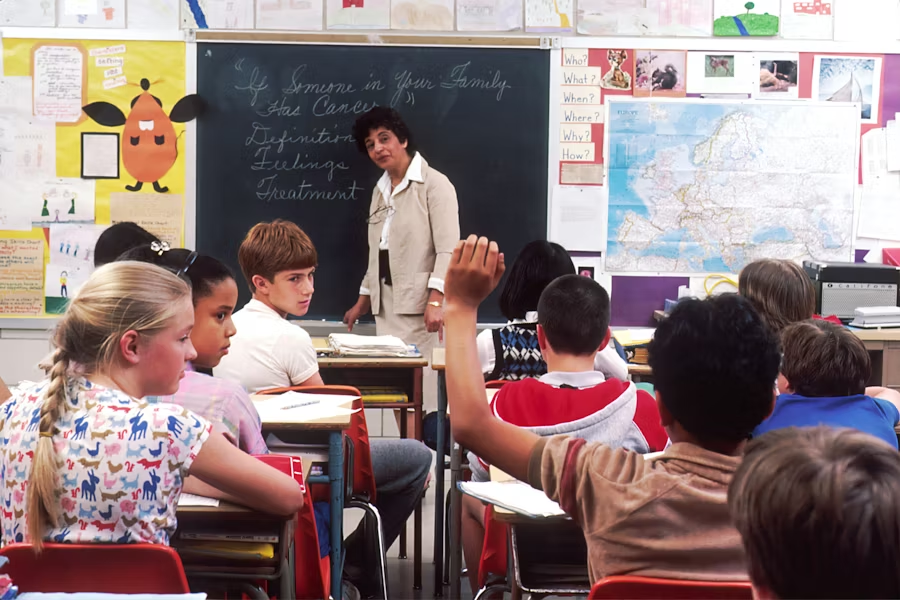
In his book, Outsmart Your Brain, Willingham says something revolutionary: he says that most children are asked to learn without ever being taught study skills, without ever being taught how to organize themselves for studying, without ever having been taught to prioritize what to study, and without ever having been taught what to do when they procrastinate about studying.
And we all know this is true because we were once those children.
Unless your kids go to a very unusual school, this will be true for them as well.
When I went to school, I remember being told that I just wasn’t “trying hard enough”. But Willingham says that wanting to learn has no direct impact on learning.
He says that we often remember things we didn’t intend to learn and we often do not remember things we did want to learn.
He also says that repetition doesn’t guarantee learning.
From junior high onward, Willingham says that school is made up mostly of three basic tasks: listening, reading and taking tests — and these are the three areas of learning he covers in his book.
He talks about so many important things. For example, he describes how to extract the important information from a lecture, a lab or a demonstration. And he goes into detail about how to take notes, and how to organize materials.
Interestingly, he also talks about the dangers of having a computer open in the classroom — even if the student is taking notes on it — and I think we all know what he means: it is tempting to look at other things and do other things while the laptop is open. Willingham suggests that students who are allowed to have laptops open in class put the laptop on airplane mode so they do not do other activities during class
Willingham even gives advice for instructors about how to present material so that it will be clearer and more easily learned. And he gives more such advice in another of his books, Why Students Don’t Like School.
Whether all of his ideas are backed up by research on the particular methods he is recommending is unclear to me. But his books are heavily referenced, he has clearly studied the existing literature on learning, and his own background in cognitive science is extensive.
You may want to read these books. You may even want to donate a couple of Willingham’s books to the principal of your child’s school and ask if they can incorporate some of what he has to say into in-service training for teachers. Furthermore, you may want to ask the principal of your child’s school to institute some new curriculum for the students on how to study and learn effectively, or even suggest that a course be offered in this subject – especially in seventh or ninth grades when learning becomes more complex. I say this because teaching kids how to learn is not a job parents should feel they have to take on entirely by themselves.
In fact, I think it would be hard to impart Willingham’s ideas to your own children. Kids often resist parents’ efforts to help them learn. But if done at school, as part of the curriculum, it seems to me that teaching strategies for studying and learning – including many of Willingham’s ideas – could be extremely helpful.
Teachers receive a lot of information about pedagogy. They go to college to learn how to teach, they go to conferences to learn more and they are often provided with materials during seminars at the schools where they work. But kids, as Willingham says, are rarely taught how to learn.
It is about time that we helped kids learn how to learn, that we helped teachers teach kids how to learn, and that we helped teachers teach in a way that makes it easier for kids to learn.
PS
This book isn’t just for parents and teachers – it can be helpful to anyone still engaged in the learning process – including at work. Check out, especially, the chapter on procrastination!
This is an excerpt from my new book, How Children Grieve: What Adults Miss and What They Can Do to Help (2024) Alcove Press.
While it is the normal order of things for a grandparent to die during the life of a child, such an event can be a salient moment: The loss of a grandparent may be your child’s first experience with death. It can bring up all sorts of feelings, questions, worries, and concerns.
But please, don’t be afraid to talk about any and all of this with your child. You don’t need special training or professional advice to do this. Just try to talk with your child simply and honestly.
If your child and their grandparent were close, it is, of course, an extremely sad and painful experience when the grandparent dies. A grandparent can be a unique source of love, comfort, and support for a child. Often grandparents indulge the child’s wants and needs more lavishly than the parents do, and as a result, your child may feel particularly sad when she loses her grandparent.
For this reason, as much love, comfort and reassurance as you can provide will be welcomed by your child. But at the same time, your child may have concerns that they are not easily reassured about.
This is OK.
Death is scary for all of us – –
but it is also part of life.
When a grandparent dies, your child can have new fears about death, and it may occur to them that you could die or even that they themselves could die.
This can raise existential issues for the child: What is death? What does it mean to die? What happens after you die?
These questions are difficult, and you may struggle to answer them.
But after the death of a grandparent, you can not only explain about death and what it is, if necessary, but you can also talk about what it means to lead a long and productive life. It can be comforting for the child to know that the grandparent was older and got to have many years of life.
However, the death of a grandparent is complicated because it often involves a double loss. Not only does your child feel her own feelings of sadness and loss, but she must also deal with the grief you and/or your partner feel. It may be a new and troubling experience for your child to see you cry or be sad for an extended period of time—and you may be less available for a while, both emotionally and in terms of doing all the things you usually do for your child.
Your child may need more from you than you feel you can provide for a little while.
You will do your best, but it is also important for you to get all the help you need with your own grief process. You may need some time to yourself, you may need to reach out to friends to talk or you may even seek some psychotherapy to help process your loss.
But eventually, your child will have feelings and thoughts that will require your attention.
For example, Kyra was 6 when her grandmother died. She and her grandma had not had a particularly close relationship as her grandmother had lived in another city and also because her grandmother was rather aloof as a person. But still, Kyra had questions. She asked her mother what happens after death. When her mother answered, “Nothing,” Kyra became preoccupied by the idea of “nothing.” What could it be like to be dead and be “nothing”? Where was her grandmother and what was it like for her? And what would happen when Kyra herself became “nothing”? Kyra didn’t speak to anyone about her worries, but she found herself thinking about being “nothing” every night while trying to fall asleep.
Or, for another example, Jacob was 12 when his grandfather died. Jacob loved his grandfather dearly and had seen him often during his first 11 years of life. He did all he could to help in the last months of his grandfather’s life, visiting often, cleaning up his grandfather’s yard, and bringing him his favorite treats.
Jacob was alarmed as his grandfather’s appearance began to change. His grandfather had married and had children late in life and he was quite old, even for a grandfather. After his 89th birthday, he started to become weaker. He became pale, and he did not feel much like eating. He was thinner each time Jacob saw him. After visits with his grandfather, Jacob would go to his room and take a nap. Clearly, being with his grandfather was something he wanted, but it was also disturbing and depleting for him. Rather than facing his disturbing feelings, he preferred to sleep.
Jacob’s parents were worried about him and asked a friend who was a therapist whether or not Jacob should continue to visit his grandfather as frequently. The friend suggested that Jacob come to see him, and he took the time to sit down with Jacob to talk with him about his grandfather. Knowing that Jacob was interested in science, the friend thought that it might help to explain what was happening inside his grandfather’s body. They talked about aging and why certain organs begin to break down. Jacob’s grandfather was very old and he had lived a long, productive life. They talked about this and they also talked about how hard it is to watch as someone you love get closer to dying.
Jacob left the friend’s house in a lighter mood. Because he was a boy who used his intellect to help him understand and process things, he had benefited from learning more about why his grandfather was losing weight and what the future might look like.
Jacob continued to visit his grandfather often, and while very sad after each visit, he seemed more able to manage his sadness than he had been previously. He got a lot of satisfaction out of helping his grandfather, bringing him his favorite ice cream, and doing chores around his grandfather’s house and yard. Eventually, Jacob also brought his homework over to his grandfather’s house and sat in the living room doing his work while his grandfather rested on the couch.
When his grandfather died at age 90, Jacob was very sad. But he wanted to go to the funeral and the graveside service and he wanted to help out at the reception afterwards. He wanted to make his grandfather’s last party nice and he worked hard to help his parents to prepare for all the visitors ahead of time.
Continuing Connections
Continuing connections to those we’ve lost are important. There are so many ways that a child can feel a continued connection to a grandparent. Often they cherish memories of things they did together. Or they replay advice their grandparent gave them. Some love to hear funny or interesting stories about their grandparent, and some will want to have something that belonged to their grandparent. Some will benefit from making an album of photos they can keep or a video they can look at whenever they feel the desire.
But of course, not all grandparents and grandchildren are close and not all grandparents are kind. Depending on the type of relationship your child had with her grandparent, the amount of grief she feels and her desire for connection will vary.
Some children may want to go to the funeral, some may want to visit the cemetery where their grandparent is buried; some may want to bring flowers or a stone to put at the grave. Some may want to attend yearly religious remembrances, and some may want to do none of these things.
In all cases, even if the relationship with the grandparent was not entirely positive, it is important for the adults in the family to bring the grandparent up in conversation from time to time so that the child knows that when someone has died, they are not forgotten and that we can continue to think about our them and to process what they meant to us throughout our lives.
But one of the most difficult things is….getting dinner on the table.
So many parents are feeling guilty about giving their kids too many processed foods –
Or just not being able to figure out what to serve their kids when they get home at the end of the day.
Getting dinner on the table for your toddlers isn’t always easy. So many parents are irritated with themselves because they are having a hard time figuring how how to give their little ones a healthy dinner on top of everything else they have to do.
Recently I was talking to the mother of two small children, ages two and four and she lamented that she had started too late trying to get vegetables into their meals.
Too late at two and four?
Yes, she said, they were onto her already – if she tried to sneak some peas into the mac and cheese, they would just eat around them.
And the research supports her.
Early exposure to a variety of flavors including bitter tastes can help a child to tolerate them. A number of studies indicate that the introduction of vegetables and fruits into an infant’s diet as soon as they start to eat solid foods is extremely helpful in getting them used to these tastes and in choosing to eat these foods as they become toddlers and young children.
So, here’s the deal, parents: start early!
As soon as your baby starts on pureed foods, offer broccoli, spinach and other non-sweet vegetables. This goes against conventional wisdom – but it’s important. And as soon as toddlers are able to eat some pasta, add veges to the mix. Don’t make a big deal of it, just serve it that way.
And if they don’t eat the veges?
Don’t stress. Just keep serving it that way. Try different veges. Eat some while your kids are watching. And again, don’t make a big deal of it. Research has shown that it may take many exposures to a new food for children to accept it.
And also – don’t make life hard for yourselves – just keep a few bags of green beans, peas and corn in your freezer. And while you’re at it, a few bags of frozen raspberries, blueberries and strawberries too.
And keep the snacks in between meals to a minimum so your kids are hungry at meal time: one small snack between breakfast and lunch, and one small snack between lunch and dinner. Peel and cut up an apple. Make a little bag of raisins. Peel a mandarin orange and cut each section in half. Cut up some cucumbers or carrots or celery and have a little ranch dressing for dipping. Make a little bowl of cut up watermelon or blueberries or some fresh or frozen raspberries or strawberries. Always have a couple of cheese sticks on hand. Keep it simple and healthy.
Continual snacking?
That’s a no.
Continual pouches they can suck on?
No.
A big brownie or cookie from Starbucks?
Also a no. (At least most of the time)
Just provide two of the snack choices I listed above and you’ll be fine.
And here are the 10 good dinners. They won’t take more than 15 minutes to prepare. I promise. (Except maybe some Sunday prep for one or two of them.) And there are no processed foods involved!
1. The favorite: mac and cheese with peas or green beans thrown into the pasta water during the last two minutes of cooking your pasta.
2. The second favorite: big square raviolis stuffed with cheese, again with a frozen vege or fresh broccoli florets thrown into the water in the last two minutes of cooking the ravioli. Add a little butter and parmesan if your kids like that. Or a little red sauce.
3. Frozen pierogies stuffed with potatoes or cheese – and again add the veges when there’s two minutes left to boiling them.
4. Baked chicken. Yes. Kids will eat this. Roast a whole chicken or bake chicken breasts and thighs. Put salt and a little garlic powder on top and bake. That’s it. Do this on a Sunday and you will have dinner for two or three meals during the week. Or, just buy a rotisserie chicken when you go shopping. For younger toddlers, remove the skin when serving and shred the meat so it’s finger food. Provide catsup or ranch dressing or mild barbeque sauce for dipping. One frozen vege, a cup of applesauce or thin carrot strips are your sides.
5. Quesadillas. Put some munster cheese slices on a tortilla, add a few small chopped vegetables, fold and microwave or bake until the cheese melts. Serve with a side of black beans or pinto beans and mild salsa – and it’s Mexican night! If your child doesn’t eat the beans, no worries. Just keep offering them when you serve quesadillas.
6. Spaghetti – boil the pasta in chicken stock with a few frozen veges thrown in at the end – and you’ll be shocked how much your kids love it when you do it this way. Use the stock sold in cardboard boxes – or just serve spaghetti boiled in water with butter and parmesan on top. No child can resist this – as you probably know already. Serve with thin carrot and celery sticks or slices of cucumber with ranch dressing for dipping.
7. Chicken or turkey tenders. Not the frozen, breaded, processed ones – just the plain ones that are sold raw in every grocery store. Saute in olive oil and add a little salt and garlic powder while sauteing. Brown them just a little bit. And let your kids eat them with their fingers with a cup of applesauce and a vege on the side. Again – catsup or ranch dressing or barbeque sauce for dipping.
8. Burgers with or without the bun. Using ground chicken, turkey or hamburger, make some small patties for your kids. Salt and garlic salt on top and saute in a little olive oil or butter until they’re done. Serve with steamed broccoli, carrot or celery strips and a dipping sauce.
9. Meatballs. Buy a good brand. Read the ingredients on the box and make sure that they only have a few in ingredients. Saute or microwave. Service with a cup of applesauce and a vegetable. IF your child likes red sauce or parmesan, put that on top.
10. Lasagna. Yes, most kids love this. Make on the weekend or buy a good brand. Serve a small amount to start and see if your child wants more.
Other hits with toddlers? Believe it or not, many love smoked salmon torn into small bits, tuna or salmon from the can, or other canned or fresh fish (although only serve once every other week because of the potential mercury content), halved cherry tomatoes, fresh raspberries, strawberries or almost any other fruit, dried cranberries or cherries, pickles. Chicken noodle soup is an old standby and many will also eat tomato soup or even pureed bean soup. Try any and all of these – and more. Expose them to the foods you love. If possible, eat what they eat and eat with them. If you don’t like the foods I’ve suggested, serve what you like and give your child some small portions of exactly what you’re eating.
And for dessert? Again – fresh fruit or frozen berries. And for some fun? Spray on whipped cream! This has very little fat and sugar. Buy a good brand without a lot of additives. And if you allow a real dessert in your house? Add a scoop of vanilla ice cream or a cookie to go with that fruit!
And most importantly? Again, sit with your children when they eat. Or better yet, eat with them.
It’s easy to fall into the habit of letting your children eat on their own while you look at your phone or do clean up.
But try not to. Sit together and talk. And make sure everyone stays at the table until they’re finished. These are good habits to get into – and to keep!
This post was written by Karen Libber Fishbein, LCSW. She is a therapist and mother who lives in Philadelphia with her husband and two daughters.
Earlier this week, the U.S. Surgeon General declared parental stress an urgent public health issue. He discussed the “dizzying pace” of the world as one of the main factors behind this stress.
As a mother of daughters ages eleven and almost nine, this statement certainly resonated with me. I find that I’m frequently feeling stressed, run down, and frazzled as I manage many of the components of day-to-day life.
I rarely felt this way before having children.
When I think back to my childhood, I don’t recall my parents being under this level of pressure. Though it was still stressful parenting at that time (the 1980’s), parents didn’t have to contend with the intricacies of the present-day digital world. Many of the strategies that worked well for parents decades ago in the analog world no longer work in the world we inhabit today. That leaves parents who are trying their best to stay afloat feeling confused, overwhelmed, and burned out!
When our daughters were two and five, the stress levels of modern parenthood were more than my husband and I could bear, and they began to negatively impact our marriage. We began couples therapy at that time (this was spring of 2018) in the hopes that our relationship struggles would improve. We ended our therapy in the spring of 2024, and what transpired over the course of the six years we were in treatment is truly miraculous.
Not only did the couples’ journey dramatically improve our marriage, it also trickled down to the kids. Once the marriage was stronger, the girls’ behavior, moods, and general well-being improved.
Children, particularly those who are sensitive and empathic like both of our daughters, can sponge off of their parents’ mental states. If the parents are in pain, the kids may take on this pain unknowingly.
The best way I can describe the process of couples therapy is that it’s a highly emotionally charged excavation of years of pent-up resentments and relational challenges. It is not easy work to do, but it is important work. For us, many sessions invoked painful feelings and realizations. My husband and I each had no idea how much unprocessed emotion had built up over the years. Unsurprisingly, many of these relational struggles predated our relationship with each other and were directly associated with childhood attachment patterns.
Couples therapy provided a safe space for us to explore all of these dynamics and it helped each of us to understand how they impact our present lives.
Today our family unit feels healthier and much more stable than it did prior to engaging in couples therapy. While an improved family system doesn’t take away the stress of modern parenthood, it certainly makes it easier to weather the storms. I’m a firm proponent of both individual and couples therapy and believe both can be vital resources during the trials and tribulations of parenthood. After receiving both forms of treatment myself, I can honestly say that the couples work has had a more profound, lasting impact on the family system than did the individual work alone.
One of my favorite seasoned therapists, Dr. Irvin Yalom, wrote an inspirational book called “The Gift of Therapy.” I read it a couple years ago and would highly recommend it to anyone interested in the practice of psychotherapy. I titled this article “The Gift of Couples Therapy,” in the hopes that it may inspire anyone, particularly parents, who may be ambivalent about the idea of therapy to pursue couples therapy. The therapy that my husband and I received has truly been a gift, and I’m hopeful it will help our family going forward and for generations to come.
If you have just had a baby—or if you have had several—and you feel lonely, it is ironic to say, but you are not alone.
Mothering—or parenting if you are not a mother—can be very lonely.
When they are first on parental leave, and later, on holidays and weekends, parents often find themselves on their own for long stretches of the day with their babies. And as much as they love their babies, it can be hard.
The routine—feeding, changing, dressing, playing, putting down for a nap—can become tedious. A parent can long for a break or some adult companionship.
As Lucy Jones says in her book Matrescence, there is a reason you feel this way.
We are not meant to parent alone.
From the time we were non-human primates, and on through the millennia of human existence, parenting was a group activity. Aunts, uncles, cousins, older siblings, grandmothers, and others helped with parenting. They were there to take a baby, watch a child, discipline a teenager.
Parents did not stay alone in their caves or huts or houses while they were taking care of their babies and children.
We are not wired for parenting alone.
Sarah Blaffer Hrdy, a cultural anthropologist, writes about this in her book Mothers and Others. She says that we are “heir to an ancient legacy endowing (us) with a penchant for cooperation” (p 65). Our primate ancestors, Homininae, were different from other primates in this way.
It is Hrdy’s hypothesis that Homininae grew up depending on a large range of caretakers.
Among current-day hunter-gatherer populations studied by the anthropologist Mel Konner, Hrdy says, babies are held at least 25 percent of the time by members of the community other than their mothers. When not hunting or gathering, Konner observed that babies were passed around from person to person, being kissed, sung to, bounced, entertained, encouraged, and addressed in conversational tones for long “conversations” (p. 76).
Among modern-day Central African peoples who forage for food, mothers share their babies with others in the community right after birth and during their infancy and toddlerhood. Among two such groups, the Efe and the Afa peoples, after babies are born and before the mother’s milk comes in, newborns are comforted by other women in the community by being allowed to suck on their nipples—whether the women are lactating or not. Similarly, babies are fed by lactating women until the mother’s own milk supply comes in.
In the Efe community, babies average 14 different caretakers in their first few days of life.
Similar patterns of shared caretaking of infants have been observed in traditional societies all over the globe.
Mothers in other societies, including our own, need this too—maybe not 14 people—but someone to hold and comfort her baby when she’s exhausted after childbirth, someone to nurse her baby while she waits for her milk to come in, someone to fill in if she’s having trouble with nursing. And what mother does not long for others to show her exactly how to nurse? Or someone to hold her baby close when she needs a break?
In our culture, babies are sent to the newborn nursery to lie in plastic isolettes while their mothers rest after delivery. Newborns may go hungry for hours while their mothers wait for their milk to come in. Some babies become dehydrated because their mothers want to nurse but don’t have sufficient milk supply. Many women suffer alone, wondering if they do have enough milk or if they are nursing correctly.
In our culture, despite the fact that there are doulas and lactation consultants, women are largely alone with their newborns and young infants. They are alone to figure out how to nurse and how often to nurse and when to wean and how to wean and well, just so many things. This is extremely hard—and unnatural!
So, what can expectant parents—and parents in general—do?
Here are some important steps to take:
Build community before your baby arrives. Identify family members who you get along with. Reach out to them and let them know that you think you will need their help after your baby is born. You may not know yet what kind of help you’ll need, but just start the conversation. No matter how you feel prior to your baby’s birth, you will need help afterward….and in the coming years. Once your baby arrives, ask those family members who seem open to it for help for the hours you need it – whether each day or each week or on an occasional basis.
Look for help outside your family: join childbirth classes and parenting classes, if not for other reasons, then to make some friends in your area who will have babies the same age as your own. Other parents are a valuable resource. Parents need to get together when their babies are little—not for the babies’ sake, but for their own. Having someone to break up the monotony of the day, or the weekend, to sit with or walk with, to exchange information with, or to complain to is absolutely necessary.
Starting when your baby is young, join whatever local community center is available, if you have the resources to do so. The local YMCA, church, synagogue, etc. will have classes you can join and they often also have daycare, where a baby can stay for an hour or more while you take a class. Having a break now and then – even if just for a one hour exercise class – is crucial.
Take your baby to the library story hour, the infant music class, a swim class, or a parenting group. Again, you need to get out of the house and meet other parents. As your baby grows, he/she will enjoy the stimulation—but you, as the parent, are the one who really needs it.
Advocate for better resources for parents in your community.
Keep reaching out to family members once your baby is a toddler. You still need help, even if it is a new kind of help, different from what you needed at the beginning.
Start some group activities for parents, babies, and children if you can’t find any. It isn’t hard to put together a little parenting group or to plan a daily or weekly meetup at a local playground – even if you just start with one other parent.
Even following all these suggestions will not replace the real 24/7 community every parent needs – but they are a beginning.
Because parenting is challenging in any circumstance, but it is excruciatingly challenging when you feel that you are left on your own to do it all.
References
Hrdy, Sarah Blaffer. Mothers and Others: The evolutionary origins of mutual understanding
When I was a child, long, long ago, after the age of two or so, kids just ate what everyone else was eating at dinner. They didn’t have a choice.
But something has changed in the last few decades. Children, especially young children, often only want to eat mac and cheese or pasta and butter and many parents are providing these.
Many parents feel that they just can’t figure out what to put on the table. They don’t have time to prepare a variety of options and they’re afraid that their children won’t eat what they provide.
I have been wondering what has happened to family eating habits and why it has happened — so I decided to read some of the scholarly literature on the subject of children’s food preferences to see if I could find any clues.
And I will tell you this: there is very little I could find.
But what I think is that children’s eating habits have changed as a function of the changes in parenting practices. We have evolved from parenting in an authoritarian manner – up through the 1950’s – to parenting in a more “child centered” fashion.
Of course the influences of psychoanalysis (on Benjamin Spock among others), developmental psychology, progressive educational theories and “pop psychology” have a great deal to do with these changes.
And we are now at a point that we now find ourselves in the age of “gentle parenting” where rules and limits are discouraged.
However – I think we have gone too far.
And this includes at the dinner table.
We now ask children what they want to eat and we let them eat it while looking at our phones – rather than providing them with a meal that we are going to eat with them.
We now encourage kids to eat in their strollers and in the car and, well, really anywhere they are.
And, as a result, many kids they may not be all that hungry at meals. Meals are not the major source of nutrition anymore.
So, let’s take a closer look: when we ask children what they want to eat, are we giving them a choice they really need to make? Are we making life harder for ourselves? And are we actually helping our children’s development?
Because we know that too many choices are not good for young children. In fact, we know that children feel safer when there are fewer choices and more rules and limits. This has been proven by the studies on authoritarian versus authoritative parenting (Baumrind et al, 1967, 1981, 1989; Steinberg, 1989, 1991; Lamborn, 1991, etc.)
From this literature, we know that children need to understand what their parents expect of them and they need to know what the consequences are if they do not do as their parents expect.
And it used to be that kids knew they were expected to at least taste what was on their plate at dinner – if not to clean their plates entirely.
Of course this does not mean that kids liked this. Children often hated these rules.
But some rules actually make sense.
Recent research has shown that it often takes many exposures to a new food for babies and children to come to accept – or even like – that food.
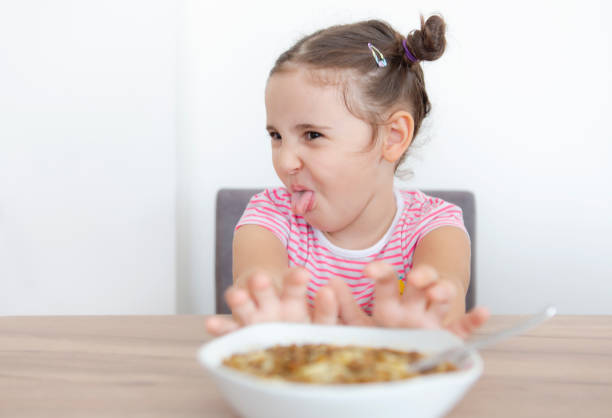
Parents do not need to give up when a baby turns her head from the spoon or when a child says “ewwwww”.
Perhaps we have given children too much choice. When we say “What do you want for dinner” or “Do you want McDonalds or pizza?” we are opening the door to their limiting their food choices to only their most favorite and well known foods.
So, what is a parent to do?
Research shows that the best thing parents can do is to present a large variety of foods from infancy on and to model eating a large variety of foods — including fruits, vegetables, a variety of protein sources, and some fun foods. In other words, it is better to make a variety of things available for dinner and not give in to the child’s desire to have mac and cheese every night.
Yes, kids, especially young kids often like bland foods – or as some parents say, “white foods”, like pasta and rice and bagels. And this makes evolutionary sense. The aversion to bitter taste has been linked to survival as poisonous plants are often bitter. And the preference for sweet foods has a similar evolutionary advantage as mothers’ breast milk is sweet.
However, research has shown that early exposure to a variety of flavors including bitter tastes can help a child to tolerate them.
A number of studies indicate that the introduction of vegetables and fruits into an infant’s diet as soon as they start to eat solid foods is extremely helpful in getting them used to these tastes and in choosing to eat these foods as they become toddlers and young children.
And the research also shows that while it may be easier to stick with just breastfeeding or bottle feeding for the first year, adding what are called complementary foods (foods that complement the breast milk or formula your baby receives) helps to promote a wider variety of food choices for these babies as they grow.
Some researchers even believe that there is a sensitive period for accepting new food tastes. These researchers found that children who were introduced to fruits and vegetables early (around 4 months for fruits and around 6 months for vegetables) ate more fruits and vegetables between ages 2 and 4 than those children who had not been introduced early (Coulthard et al.).
The same thing goes for textures. After introducing pureed foods (at around 5 months), it has been found that introducing slightly lumpy foods (around 6 months) and then foods that need a little chewing (around 7 months) is helpful in the long-term acceptance of foods with various textures, including complex ones. From 6 to 12 months, babies learn to use their tongues to move food around their mouths, and they need experience with foods of various textures in order to do so. Of course, parents need to sit with children of this age while they eat in order to observe whether they are having any trouble with swallowing these varied textures (Gisel et al.).
One study actually found that children introduced to lumpy solids later (after the age of 10 months) had more feeding problems when they were 7 years old. These 7-year-olds were also reported to eat fewer portions of fruit and vegetables than those who had been introduced to lumpy and textured foods earlier. In fact, those infants who were introduced to complementary foods by 6 months ate more green, leafy vegetables, tomatoes, and citrus fruits at age 7 than those who were introduced later.
Another factor that affects children’s eating habits are their parent’s own eating habits and attitudes towards food.
In regard to parental behaviors and how they affect children’s food choices, it has been found that parents who are less consistent and less predictable in regard to what and when they eat tend to have children with more chaotic eating habits. And it turns out that the more parents are inconsistent or erratic in their eating schedules, and the more their diet varies between healthy and less healthy options, the worse the influence on their children’s eating patterns (Ventura et al.).
In particular, the relationship between mothers’ eating habits and children’s eating behaviors has been studied. And it has been found that mothers who restrict their own eating can actually promote overeating in their children, especially in their daughters. Girls who were already overweight at 5 years of age whose mothers tried to restrict their eating had the highest tendency to eat when they were not hungry. And Birch et al. showed that mothers tend to increase control after their daughters gain weight but not so much after their sons gained the same amount of weight.
Limiting snacking between meals to one snack between breakfast and lunch and one snack between lunch and dinner has also been found to be best once the child is old enough to eat just three meals a day.
Moreover, providing snacks that are not composed of nutrient-dense, high-calorie ingredients is preferable. So this means that those big brownies and cookies from Starbucks are definitely not the best snacks to offer on a regular basis. Try providing yogurt and fruit, some peanut butter on pretzels or apple slices, some raisins or a couple of small cookies, a glass of milk and some fruit slices, and see how it goes.
This is a lot to digest, parents – but evidence shows that starting early with all sorts of tastes and textures, providing lots of variety at meals, persisting with getting kids to taste new foods, being aware of and addressing your own eating habits, and cutting back on high calorie snacking can be best for everyone in your family.
References
Ventura AK, Birch LL., Does parenting affect children’s eating and weight status? Int J Behav Nutr Phys Act, 5 (2008), pp. 15-27
Blossfield I, Collins A, Kiely M, Delahunty C. Texture preferences of 12-month-old infants and the role of early experiences. Food Qual Prefer. 2007;18:396–404
Coulthard H, Harris G, Emmett P, the ALSPAC team. Long term consequences of early fruit and vegetable feeding practices. Public Health Nutr. 2010;13(12):2044–51.
Baumrind, D. (1967). Child care practices anteceding three patterns of preschool behavior. Genetic Psychology Monographs, 75, 43–88.CASPubMedWeb of Science®Google Scholar
Baumrind, D. (1971). Current patterns of parental authority. Developmental Psychology Monograph, 4(1), part 2.Web of Science®Google Scholar
Baumrind, D. (1989). Rearing competent children. In W. Damon, (Ed.), Child development today and tomorrow (pp. 349–378). San Francisco : Jossey-Bass.Google Scholar
Steinberg, L., Elmen, J., & Mounts, N. (1989). Authoritative parenting, psychosocial maturity, and academic success among adolescents. Child Development, 60, 1424–1436.
Steinberg, L., Mounts, N., Lamborn, S., & Dornbusch, S. (1991). Authoritative parenting and adolescent adjustment across various ecological niches. Journal of Research on Adolescence, 1, 19–36. Child DevelopmentVolume 62, Issue 5 p. 1049-1065
Maccoby, E., & Martin, J. (1983). Socialization in the context of the family: Parent-child interaction. In E. M. Hetherington (Ed.), P. H. Mussen (Series Ed.), Handbook of child psychology: Vol. 4. Socialization, personality, and social development (pp. 1–101). New York : Wiley.
Gisel EG. Effect of food texture on the development of chewing of children between six months and two years of age. Dev Med Child Neurol. 1991;33:69–79.
Kirby S, Baranowski T, Reynolds K, Taylor G, Binkley D. Children’s fruit and vegetable intake: socio-economics, adult, child and adolescents in the United States. Arch Pediatr Adolesc Med. 1995;150:81–6.
Mason S, Harris G, Blissett J. Tube feeding in infancy: implications for the development of normal eating and drinking skills. Dysphagia. 2005;20(1):46–61.
This is the seventh post in a series on The Transition to Motherhood.
In her book, Matrescence, Lucy Jones discusses the idea that society — and women themselves — often feel that childbirth and caring for young children diminish their memory and cognitive capacity. While they are pregnant and after they give birth, women often complain of not being able to remember anything, being scatterbrained, or feeling stupid.
But when looking at the research, Jones found the opposite!
In fact, it seems that having a baby concentrates the mind. Brain structure and the neurochemistry of the brain actually change during and after pregnancy in order to aid the mother to tune into her baby and her baby’s needs. It may be that some of the old things the mother used to think about are less the focus of her attention after her baby arrives and she may feel less capable of concentrating on them — but this is far different from being “stupid.”
In fact, Bridget Callahan, a researcher at UCLA, found evidence of enhanced learning, memory, and cognitive capacity after childbirth (Callahan, et al, 2022).
Of course, this makes sense, because new mothers need to expand their ability to tune in to their babies, to learn what helps and doesn’t help their babies to feel comfortable, and to learn how to solve the many problems of everyday childcare.
In fact, in reviewing the literature, researchers Erika Barba-Müller et al found that there are structural and functional changes in the woman’s brain both during pregnancy and following delivery which stimulate her to progress from being an individual with self directed needs to being responsible for her baby. These changes are highly adaptive and aid in the woman’s transition to motherhood.
Similarly, in a review of the literature, Winnie Orchard found that there is evidence that the brains of pregnant women become more flexible, efficient, and responsive.
Minor difficulties in word finding and short-term memory often make women feel less competent during pregnancy and early motherhood — but this is not all that is going on.
Referring to Orchard again, Lucy Jones says that the lifetime impact of motherhood on cognition and the brain may be positive and that the cognitive load of adapting and adjusting to one or more growing children may help the brain to be resilient.
Think about it: So many people have started doing the daily word puzzles put out by the New York Times — as well as doing all sorts of gaming apps on their phones — in order to preserve and enhance their cognition. But these do not provide even a portion of the challenge that comes up in a day for the parent of a newborn or child of any age!
For a first-time mother — and her partner — the day they come home from the hospital is often a terrifying day. Suddenly, they realize that it is up to them to figure out how to care for their new baby and to keep them alive. Soon it is clear that caring for a newborn requires a completely new set of skills. And there is a great deal of trial and error. Every day new problems need to be solved. So much has to be learned — not just about babies in general — but about this particular baby, her sensitivities, and her preferences. And then, just as the parents are getting the hang of it, the baby starts a new sleep pattern, develops new feeding preferences, or enters a new developmental stage. And learning how to deal with these things requires a great deal more problem-solving.
So as for “Mom Brain” — yes, there is such a thing, but it is not what we often think it is. The Mom Brain is a more flexible, more competent, more resilient brain than the non-mom brain.
References
Barba-Müller, et al (2019). Brain plasticity in pregnancy and the postpartum period: links to maternal caregiving and mental health. Arch Womens Ment Health. 2019; 22(2): 289–299. Published online 2018 Jul 14. doi: 10.1007/s00737-018-0889-z
Callaghan, B. et al., (2022) “Evidence for cognitive plasticity during pregnancy via enhanced learning and memory”, Memory 30(5) , p. 519-536.
Jones, Lucy (2023). Matrescence.
Orchard, E. R., et al., (2022) “The maternal brain is more flexible and responsive at rest: Effective connectivity of the parental caregiving network in postpartum mothers”, bioRxiv
In her book, Matresence, Lucy Jones says that pregnancy is a metamorphosis. Like a caterpillar that becomes a butterfly, the woman’s previous identity must melt away in order for her new identity and concept of self to emerge.
And during her own first pregnancy, Jones found this process very disturbing. She says, unlike other stages of life for which there are parties and ceremonies to mark the transition of one stage of life to another, during pregnancy, for which there are no ceremonies in our culture which celebrate the mother, the woman can feel profoundly awkward and alone.
Jones talks about how, during adolescence, she felt similarly awkward. She felt like she didn’t know what was going to happen next or how to be; she felt unsettled by the changes in her body.
But, she says, she had friends going through the same thing and films and articles and music which addressed the strangeness and alienation of adolescence, so she didn’t feel completely alone.
But as she went through her pregnancy, she did not feel accompanied. Part of this may have been because she, herself, did not understand what was happening to her mind, her body, or her self — and therefore she could not really talk about it with others.
She says that missing from pregnancy books or health apps was information about how pregnancy affects a woman’s mind – and her actual brain. She quotes Rosemary Balsam from the Western New England Psychoanalytic Society as calling this the “vanished pregnant body.”
She suggests that the very idea of the pregnant woman, of being two people in one, may make other people uncomfortable.
For example, there’s the the story of the runner, Allyson Felix. Felix was an Olympic medalist and many time US National Champion when she became pregnant. One of her sponsors, Nike, cut her pay by 70% and refused to offer her reasonable pay protection during her postpartum period. Felix reports being told “runners should just run” – in other words, women runners should not be pregnant.
Clearly having a premier spokesperson be pregnant was uncomfortable for Nike. And Jones talks about how it was uncomfortable for her – as it is for so many women — and not just because of the bodily changes, but also because of the emotional disequilibrium she felt and because of the changes in the way she perceived others as seeing her.
Experiencing this was hard for Jones because she felt external pressure to “pretend that pregnancy was a less dramatic and drastic event” than what she felt it to be.
And it is a dramatic and drastic event. For all women.
Thank goodness for Lucy Jones for saying so and letting us all heave a sigh of relief. We didn’t have to say it. But she did.
Toward the end of her pregnancy, Jones describes bowing out of work and not feeling guilty. She realized this was not typical of her — but she felt that she wanted to be at home and she didn’t mind being alone. She says that she felt “calm and placid, pleasantly vague, like nothing could touch me”.
Later she found out that this is normal — that there are physiological changes that accompany each of the many stages of pregnancy and that at the end of pregnancy, the reactivity to stresshormones is dampened. No wonder she didn’t feel the normal pressure to work and perform and please her boss. And luckily for her, she had the ability to step away.
The biology and neurobiological literature supports Jones. When she reports that she felt that her brain was changing during her pregnancies, she was right. In one study by Niu et all (2024), ten pregnant women were followed over the course of their pregnancies. Changes in brain structure were charted. Reductions in gray matter volume were found over the course of pregnancy. In other words — the pregnant woman’s brain actually shrinks! Their conclusion? There are profound neurobiological changes during pregnancy.
Moreover, in a review of the literature, Esel (2010) found evidence that the brains of pregnant women and women with children are very different from the brains of women who have not had children who are within the same age range. Moreover, Esel found ample evidence of neurobiological and hormonal influences on women and their feelings and behavior. She says that maternal behavior develops over the course of a woman’s life, including during pregnancy. This happens through the development of special neural networks, which are cooperatively developed by genetic, environmental, and hormonal factors.
In fact, the biology is fascinating. Esel points out the importance of hormonal influences in preparing women for motherhood. She says that estrogen, prolactin, and oxytocin stimulate maternal behavior after birth — and that the stimulation of the vagina during birth initiates the release of oxytocin, so important for the initiation of maternal behavior as well as milk production. She also discusses the finding that women are prepared to become mothers from their own birth. She says that early exposure to estrogen during the perinatal period in their own early lives may be responsible for women’s greater interest in and facility with social relationships over that of men. She suggests that this capacity primes women to be interested in and to relate to their infants once they become mothers. Then, during pregnancy the capacity for relating to their own infants is further primed by the high levels of progesterone and estrogen which are secreted. Furthermore, she says that the hormonal exposure of the brain during pregnancy plays an important role in the development of maternal neural networks and systems.
In the same vein Esel says that in humans, the ability to establish social relationships is inversely related to levels of fetal testosterone both in females and males — so in other words, men, from birth, are less primed to establish social relationships.
No wonder women feel different when they are pregnant — and no wonder they feel a shift in both body and identity. The hormonal influences on their brains, their bodies, their feelings and their behavior are powerful.
I look forward to reading the rest of Jones’s book to find out more about the research on the physiological and psychological changes that come about during pregnancy. I know too little about this.
In fact, most of us know too little about this.
Scientists are looking at aspects of the woman’s experience during pregnancy in a way that they might not have considered doing years ago, even though we have needed this information for a long time. But perhaps, as Jones suggests, science waited until there were enough women in the field to make this a priority.
Yanbin Niu, Benjamin N. Conrad, M. Catalina Camacho, Sanjana Ravi, Hannah A. Piersiak, Lauren G. Bailes, Whitney Barnett, Mary Kate Manhard, David A. Cole, Ellen Wright Clayton, Sarah S. Osmundson, Seth A. Smith, Autumn Kujawa, Kathryn L. Humphreys (2024). Neurobiological Changes Across Pregnancy: A Longitudinal Investigation, bioRxiv, The Preprint Server for Biology doi: https://doi.org/10.1101/2024.03.08.584178
Let’s take a deeper dive into the transition to motherhood in this, the fourth post in a series on this subject.
In the Introduction to her beautiful book, Matrescence, Lucy Jones says, “Pregnancy, then birth, and then – big time – early motherhood, simply did not match up with the cultural, social, and philosophical narratives I had grown up with…I started to realize that that my mind had been colonized by inadequate ideas about womanhood, about motherhood, about value, even love… A sense that I had been fundamentally misinformed about the female body and maternal experience set in fast” (p. 9, 10).
She describes how, during her pregnancy she noticed changes in herself which she had no language to describe – but she noticed that her “consciousness felt different: restructured or rewired” (p. 10).
She says, “I thought the baby would grow inside my body, …that I would still be the same person. But that didn’t seem to be the case” (p. 10).
I think that many if not most women feel all of these things. But do they have the language to speak about them? Or do they feel permitted to speak about them?
I suspect not.
Jones talks about how ill prepared she was for motherhood – how she had never changed a diaper and knew nothing about what it took to raise and take care of another human.
And I think many women feel this way – especially with their first babies.
Jones speaks about her guilt if she tried to do anything just for herself during those first months of motherhood.
She also writes about the idea that women are supposed to have a built in maternal instinct and how this works against the acknowledgement that motherhood absolutely requires the acquisition of knowledge and skills about babies, children and mothering.
And in saying this, I think Jones puts her finger squarely on the shame and embarrassment many mothers feel when they don’t know what the right thing is to do for their baby – whether it is something as simple as whether to put them down for a nap or something as complex and important as when to call the pediatrician.
As she says, “this is a set up in which mothers (are) destined to fail” (p. 11).
She says, “I thought early motherhood would be gentle, beatific, pacific, tranquil, bathed in a soft light. But actually it was hard core, edgy, gnarly” (p. 14).
Finally, we have someone who tells the truth about motherhood.
We have needed a Lucy Jones for a long time.
Women feel that they are not allowed to talk about the utter fatigue, boredom, tedium, panic and downright hardship of childcare. Yes, the difficulty of juggling work and child care is talked about. And the under valuation of parenting work is mentioned now and then. But as a society? We do not have much of a discussion around many of these issues – and we certainly have not made changing any of them a priority – in our own minds, with our partners and friends, or at the ballot box.
There is still pressure to put on a good face as a mother, to treat the work we do as joyous and to present that point of view to anyone other than our closest and most trusted friends and fellow parents.
Jones calls this “cultural apathy”. And she says that many women feel that they themselves are to blame for the extent of their troubles as new mothers. However, the fact is that a majority of women feel anxious after having a baby, at least 45% report feeling low, and at least 35% describe themselves as depressed. One in five mothers do not tell anyone about their feelings and over half report not feeling supported by their families. Almost half say they feel like they have to handle everything alone.
But there is hope. Jones writes about a burgeoning field of neurobiology that is looking at the changes in the brains of pregnant women and those who care for young infants. And she quotes Alexandra Sacks, a psychiatrist interested in this subject, as saying that simply by talking about the difficulties inherent in transitioning to motherhood, many women will feel relief.
And this is why, Jones says, she wrote her book: as an invitation to start talking about the process of becoming and being a mother.
A while back I wrote a post on matrescense, or the transition to motherhood, which seems to have struck a chord. This post is the second in a series on this subject.
To give some background, matrescence is a terms that was coined in the 1970’s by medical anthropologist, Dana Rafael, in her book, Being Female: Reproduction, Power and Change. More recently, the term was brought back to our attnetion by Aurelie Athan, a reproductive psychologist at Columbia University.
Athan notes that Rafael “pointed out that in many cultures, the birth of a new baby is announced by saying, “a woman has given birth.” Athan’s point is that the focus is on the mother and what she has done. And that emphasis is important. The mother is given credit for what she has accomplished. This is symbolic of the meaning the culture gives to the event and how it is handled. In cultures other than our own, mothers are often more supported after the birth of a baby, and more taken care of.
For example, in South Korea, it is common for mothers to go to a retreat for the first 21 days after they give birth. There, fresh meals are delivered three times a day, they can receive massages and facials and attend childcare classes, and there are nurses available to watch over the baby if the mother needs a rest.
There is a special soup to drink, traditional in South Korea during the postpartum period, lactation consultants and exercise routines to help with recovery, and body realignment to help new mothers get back in touch with their bodies.
In South Korea, eight out of ten mothers go to such a spa after giving birth.
This is the kind of thing that mothers in the United States can only dream about.
Here, mothers are often isolated in their own apartments or homes after their babies are born. During their leave from work, they often struggle with feelings of loneliness and anxiety. And this is especially true for first time moms who are not entirely sure what they are doing.
For example, a New York Times article profiled Alicia Robbins. When she had her first two children, she, like almost every woman who has birthed a child before her in this country, felt overwhelmed upon leaving the hospital. Never mind that she herself is an obstetrician and gynecologist. She said, having a child “was way harder than I expected. I kept wondering if it was OK that breastfeeding was so difficult or that I felt anxious. I kept asking myself, ‘Is this really my new normal?’”
Her mother came to help her, “but she kind of froze,” Dr. Robbins said. “I love her, God bless her, but we had fights over things like whether you need to sterilize the breast pump for three hours.”
In this country, as Aurelie Athan says, we talk about the baby, not the mother. We pay attention to the infant, give gifts to the infant, visit the infant….and we don’t talk so much about what the mother has accomplished and what we can do for her.
But the process of becoming a mother is something that we, in our culture, need to pay more attention to. As Daniel Stern said in his two books, The Motherhood Constellation and Becoming a Mother, giving birth to a new identity may be as hard, or even harder than the act of giving birth to the actual baby.
Becoming a mother changes who a woman feels herself to be. It expands her identity — but, as with many changes, this expansion can be fraught with uncertainty and anxiety. Who am I now? Do I know how to be a mother? Am I doing the right thing? What kind of mother do I want to be? Can I ever get back to doing the things I used to like to do? And if I do, will I be neglecting my baby? Can I still work? How much should I work? Can I still be good at my job?
The questions are endless.
Additionally, becoming a mother changes a woman’s identity as a partner. And this is not always easy. Sometimes a woman wonders if she still has room in her emotional repertoire for her partner. Sometimes the partner is jealous of the time a woman spends with her baby. Sometimes a woman feels she can only share her body with one person at a time and she feels resentful of other demands being made on her or torn about who that person should be — the baby or the partner? Often, a mother and her partner differ on how they each feel caring for the child should be handled. Conflicts come up over sleep training or how much of a schedule the baby really needs. And the energy for talking through these conflicts can be in short supply. Women often feel they carry more of the mental load for making doctor’s appointments, reading up on child development, and thinking about what the baby needs.
This identity shift is especially difficult, as a new mother needs her partner for support, and any resentment, difference of opinion, or outright conflict can get in the way of feeling supported.
The identity shift a woman faces after giving birth is hard. Like shedding a skin that no longer fits, the woman must say goodbye to aspects of herself and ways of being and doing that were part of her previous self, and she must grow into her new role as she works out what that will be.
Just knowing that all women experience this, that having a hard time with this shift is normal, and that it can be named and learned about — and even, in some cases, talked about with other mothers — can be helpful to new mothers.
I recommend that anyone suffering from this transition reach out — whether to friends, other new mothers, more experienced mothers, or even to a therapist who can discuss these issues openly.
After my last post, one such mother reached out to me and said that she felt less alone just knowing that what she was feeling was not unique to her.
****************************
For more good discussion of this subject, see the references section below and watch this blog for part 3 of this series.








 Thoughtful Parenting